

IATF 16949 certified hot melt adhesive for automotive applications sits at the center of modern Tier 1 and Tier 2 supplier qualification. Without this certification, most automotive OEMs will not place your bonding material on their approved-vendor list, regardless of test data or price. This guide explains what IATF 16949 actually requires from an adhesive producer, how the standard differs from ISO 9001, and what automotive buyers should verify before signing a supply contract.
What IATF 16949 Means for an Adhesive Manufacturer
IATF 16949 is the global quality management standard for the automotive industry, published by the International Automotive Task Force and adopted by virtually every major OEM and Tier 1 supplier. It is built on the ISO 9001 platform, then layers in automotive-specific requirements for defect prevention, variation control, and traceability throughout the supply chain. For an IATF 16949 hot melt adhesive automotive supplier, certification is not optional. It is the price of entry to OEM-approved bonding.
The 2016 revision tightened the link between QMS and process results. Every bonding application has to be linked back to a documented process FMEA, control plan, and a defined reaction plan when critical characteristics drift. A typical automotive cabin-air-filter line, for example, has at least three Control Points where adhesive temperature, viscosity, and bead weight are statistically monitored. Without that infrastructure, the audit fails on day one.
| Requirement | ISO 9001 | IATF 16949 |
| Process FMEA | Optional | Mandatory for every special characteristic |
| Production part approval (PPAP) | Not required | Required for new or modified parts |
| Traceability | Batch level | Lot / batch / serial, per shift |
| Risk management | General | Documented for each product family |
| Audit cycle | Annual surveillance | Annual + on-site customer audits |
Automotive Performance Requirements for Hot Melt Adhesive
Automotive bonding environments are unusually punishing. Cabin filters see temperatures from −40 °C to +85 °C across a service life; engine-adjacent filters run hotter still, and battery-cell packs in EVs add a continuous 60 °C soak. The adhesive chosen for these assemblies has to maintain peel strength through every thermal cycle without creeping or crystallizing. Standard packaging-grade EVA is rarely enough. Adhesive producers qualifying for automotive lines typically run a portfolio of PO, polyamide, and reactive PUR grades to cover the temperature band, as documented in our automotive air filter application notes.
Three test results carry the most weight in supplier qualification. First, peel strength after 168 hours at the highest service temperature. Second, low-temperature flex at the storage minimum — the adhesive must remain flexible rather than cracking on cold start. Third, plasticizer migration, which can bleed into PU foam or rubber gaskets if the formulation is wrong. Buyers should expect certificate-of-analysis data for every lot, not just the first article. The Adhesive and Sealant Council maintains testing protocols widely used by automotive OEMs.
Traceability From Raw Material to Shipped Lot
IATF 16949 requires traceability that survives an OEM recall. Each shipment of adhesive has to carry a unique lot number linked back to the raw-material batches (resin, tackifier, wax, antioxidant), the production line, the shift, the operator, and the QC test results. If a defect surfaces six months after delivery, the supplier must be able to reconstruct the exact material inputs in minutes, not days. This is what distinguishes a real IATF shop from a copy-paste certificate on a brochure.
Devote’s traceability system logs every kettle of adhesive with a serialized QR code. Customers scanning the case label can pull the production date, line, raw-material lot IDs, and a downloadable COA. For OEM-grade release, we extend the trail to the pallet level so customers can reconcile shipments against their own production records. The same traceability discipline applies to our high-temperature-resistant automotive HEPA adhesive grade.

Devote’s Certifications and Quality System
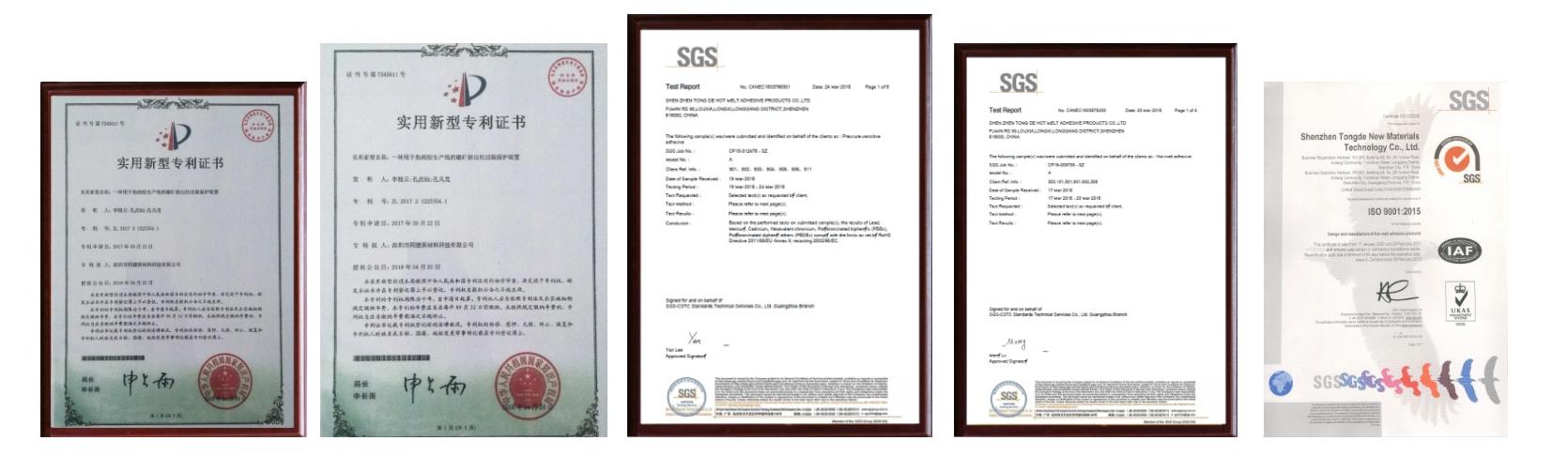
Devote holds ISO 9001:2015 certification across all production lines serving general industrial customers, and IATF 16949 certification for the dedicated automotive production cell that includes our folded-paper automotive filter adhesive line. The automotive cell runs to a separate quality manual, separate SPC charts, and a separate PPAP file structure. Lot-level COAs are issued by default and archived for a minimum of seven years to match typical OEM retention requirements.
Independent lab validation backs every release. Each quarter we send retained samples to third-party labs for re-test against the original acceptance criteria. The test schedule is published in our company profile and is available on request for any qualified buyer. This combination of third-party testing, full traceability, and certified QMS is what OEMs actually want from their adhesive partner.
What Buyers Should Verify Before Signing a Supply Contract
A useful supplier audit checks more than the certificate on the wall. Confirm the supplier’s IATF 16949 certificate is current, was issued by an IATF-recognized CB, and explicitly names the automotive production scope. Ask for the most recent internal audit summary and any open non-conformities. Review the FMEA and control plan for at least one product family. Run a plant visit if the volume justifies it, and check that change-control notifications are mandatory for any raw-material or process modification.
For buyers evaluating multiple suppliers, a side-by-side comparison simplifies the decision. The matrix below is a starting checklist adapted from automotive industry best practices.
| Checkpoint | What to ask for | Why it matters |
| Certificate validity | Current IATF 16949, automotive scope | Confirms QMS at audit level |
| PPAP submission | Level 3 or higher, recent sample | Validates first article |
| COA per lot | Yes, with traceability ID | Needed for incoming inspection |
| Third-party testing | Schedule on file | Independent validation |
| Change control | Written notification | Avoids silent reformulation |
| Capacity reserve | Documented contingency plan | Protects supply during spikes |
If a supplier can answer all six checkpoints cleanly, they are positioned for an OEM-approved relationship. If any answer is vague, walk away — the cost of a line stoppage from a mis-formulated adhesive will exceed any procurement savings.
Is IATF 16949 required for Tier 2 automotive suppliers?
In practice, yes. Most OEMs require IATF 16949 at every level of the supply chain that affects the final vehicle, even when the regulatory requirement technically stops at Tier 1. Material suppliers to a Tier 1 are usually required to hold IATF 16949 themselves or to maintain a strict quality agreement with one that does.
How long does IATF 16949 certification take?
For an established ISO 9001 manufacturer, the typical timeline is 9 to 12 months of internal preparation plus 3 to 6 months for the third-party audit. Greenfield plants usually need 18 to 24 months before they can be audited. Lead time depends heavily on how mature the existing QMS documentation is and whether automotive-defect prevention training has reached the shop floor.
Does IATF 16949 cover environmental and safety requirements?
IATF 16949 focuses on product quality and process control; it does not replace environmental or occupational health certifications. Adhesive plants typically carry ISO 14001 for environmental management and ISO 45001 for occupational health and safety alongside IATF 16949. Buyers should confirm those certificates are current as well, especially for plants exporting into the EU.
Devote is a Shenzhen-based manufacturer of eco-friendly hot melt adhesives with ISO 9001, IATF 16949, and FDA-aligned grades spanning EVA, PO, PA, PES, and PSA chemistries. Need a quick quote or a sample certificate pack for an upcoming OEM audit? Learn more about our quality system, or send your requirements directly to our team.

