

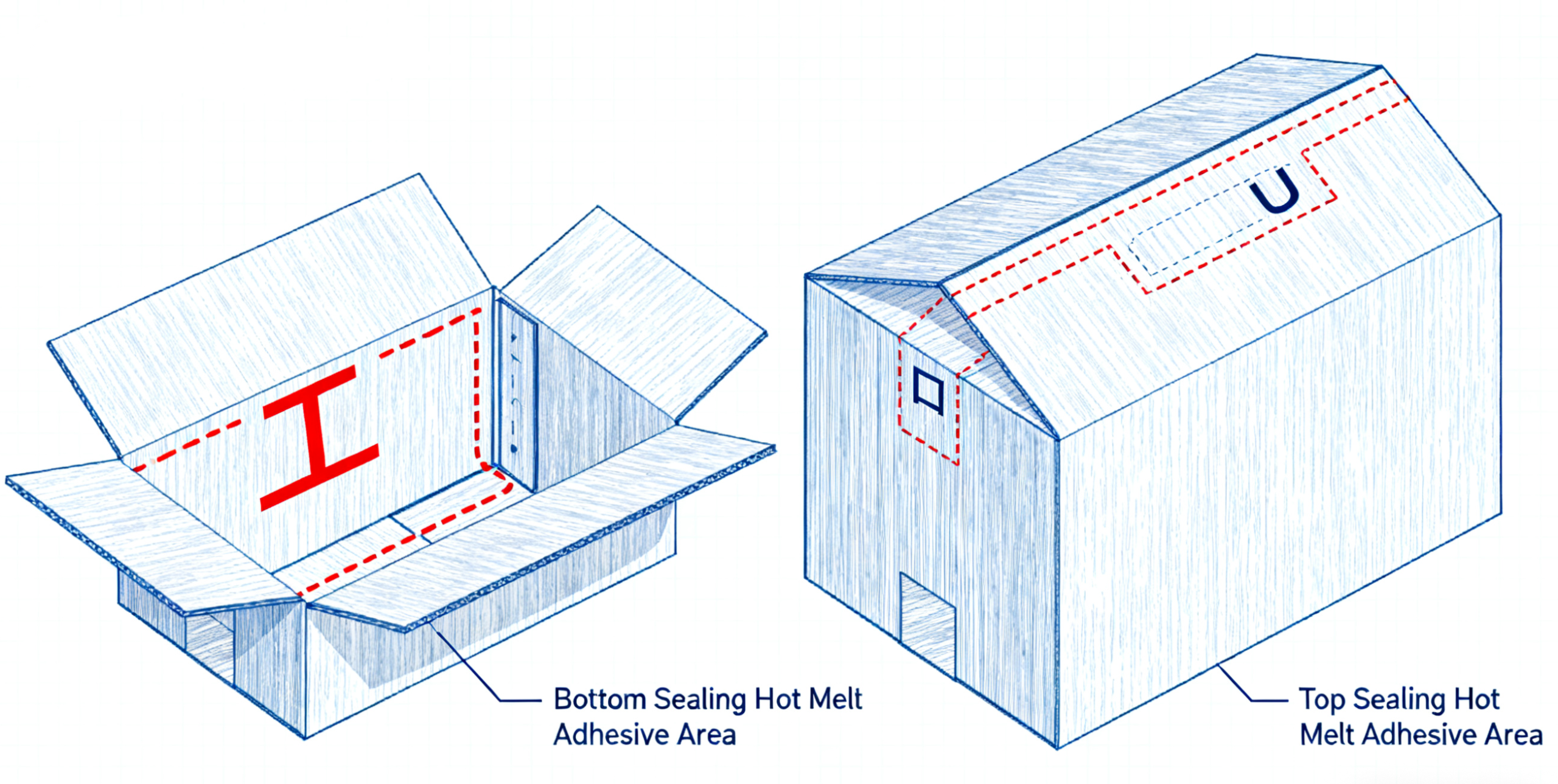
Hot melt adhesive for packaging carton sealing has become the default bonding choice on modern filling and case-packing lines. Unlike water-based glues or tape, hot melt adhesive packaging systems cure in seconds, hold instantly, and keep totes, cases, and cartons intact through cold chains and long-haul transit. This guide covers carton sealing, case sealing, low-temperature performance, high-speed line setup, and the EVA grades Devote recommends for reliable, food-contact-conscious packaging. For a closer look at how we apply these bonds on real lines, see our carton sealing application notes.
What Packaging Adhesive Must Deliver
A packaging line asks more from adhesive than most people expect. The bond must form in under a second on a moving belt, survive a drop test, stay closed in a humid warehouse, and never bloom or odor-transfer into the product. Hot melt adhesive meets these demands because it is a 100% solids thermoplastic: no water or solvent to evaporate, so green strength appears the moment it cools.
The trade-offs are straightforward. Water-based glues are cheap but slow and can wrinkle coated stock. Tape adds cost per carton and fails in cold storage. Hot melt gives the fastest cycle and the cleanest seal, which is why it dominates packaging industry automation. The only real constraint is heat stability in hot vehicles, addressed through grade selection below.
| Method | Set speed | Cold-chain hold | Cost / unit |
| Hot melt adhesive | 0.5–2 s | Excellent | Low |
| Water-based glue | 5–30 s | Good | Low–Medium |
| Pressure tape | Instant | Fair | Medium–High |
Carton Sealing with Hot Melt Adhesive
Carton sealing is the highest-volume use of hot melt adhesive packaging carton sealing worldwide. A precisely metered bead is laid on the flap seam as the carton closes, the compression section holds for a beat, and the seal is ready before the next carton arrives. The result is a tamper-evident, fiber-tear bond: opened cartons rip the board rather than the glue, a clear signal to handlers and customers.
For coated and laminated cartons, open time matters more than peel strength. Devote’s 1018C packaging adhesive is formulated for coated recycled board, giving a wide open-time window that tolerates minor line gaps without stringing. Typical application weight is 2–4 g per linear meter of seam, enough for a secure closure at minimal material cost.
Case Sealing on the Hot Melt Packaging Line
Case sealing scales the same principle to heavier RSC and HSC boxes bound for distribution. Here the adhesive must absorb shock loads during palletizing and transit. A two-bead pattern on the major flaps, or a combination of beads and dots, spreads stress and prevents the corner lift that single beads allow. Many plants run case sealing at 20–40 cases per minute, so consistent bead weight is the difference between a clean line and a jam.
When cases move into cold storage or export containers, the bond sees thermal cycling that can embrittle a poor grade. Pairing a resilient EVA with correct compression time keeps the seal flexible down to freezer temperatures, which we cover next.

Cold Temperature Performance
Standard EVA grades stay flexible to about 0 °C, which covers ambient warehouses. Below that, in chill and freezer distribution, an unfilled or low-tack grade can stiffen and lose adhesion to coated board. The fix is grade selection plus a small bump in application temperature to improve wet-out. For deep-freeze case sealing, polyolefin (PO) hot melt grades hold bond strength where EVA starts to crack.
Field data from Devote trials shows the pattern clearly. At −18 °C, a typical packaging EVA retains roughly 60% of its room-temperature peel on coated board, while a PO-grade formulation retains above 90%. The right choice depends on how cold the chain gets and how long the case sits there.
High-Speed Line Considerations
On high-speed lines, adhesive behavior is governed by viscosity and open time more than by grade name. Too low a viscosity strings and mist; too high a viscosity starves the nozzle. Devote tunes viscosity for each customer’s tank and gun so the bead stays round at 25–35 cases per minute. Compression section length, often overlooked, should give the seam at least 0.3 seconds under pressure for a fiber-tear seal.
Preventive upkeep matters as much as formulation. Charring from running tanks too hot is the top cause of nozzle clogging and stringing. Keep tank temperature within the grade’s window, filter melt weekly, and most line complaints disappear. The Fibre Box Association publishes closure and compression guidance that aligns with these settings.
Why Devote Recommends EVA for Packaging
For the bulk of carton and case sealing, EVA hot melt adhesive is the cost-performance sweet spot: fast set, good tack on coated board, low odor, and easy cleanup. Devote supplies food-contact-conscious grades and will match viscosity, open time, and softening point to your board and line speed. The table below maps common needs to a starting grade.
| Need | Starting grade | Notes |
| General carton sealing | 1018C (EVA) | Coated board, 2–4 g/m |
| Fast case line | High-flow EVA | Lower viscosity, anti-string |
| Chill / freezer | PO-grade | Flexible to −18 °C |
| Low-odor / food cartons | Low-VOC EVA | Minimal bloom |
Is hot melt adhesive safe for food packaging?
Yes, with the right grade. Devote supplies food-contact-conscious EVA formulations and can provide compliance documentation for indirect food contact. Always confirm the specific grade and intended use with our team before production.
Can hot melt adhesive seal frozen or refrigerated cartons?
It can. Standard EVA covers chill storage, while polyolefin grades maintain bond strength in freezer conditions down to −18 °C. The key is selecting the grade for your lowest expected temperature, not your average one.
What open time do I need for case sealing?
For most case sealers, a 1–3 second open time is sufficient at line speeds up to 35 cases per minute. If your compression section is short or your board is coated, choose a grade at the longer end of that window to avoid open-time failures.
Devote is a Shenzhen-based manufacturer of eco-friendly hot melt adhesives, with ISO 9001-certified production and grades spanning EVA, PO, PA, PES, and PSA. Curious whether your line would run better on a tuned grade? Learn more about Devote, or talk to our engineers about a sample and on-site tuning.

