Hot Melt Adhesive for Hygiene Products: Diapers, Sanitary Napkins and More
Hot melt adhesive for hygiene products — including diapers, sanitary napkins, adult incontinence pads, and medical underpads — is one of the most technically demanding segments in the adhesive industry. These applications require adhesives that bond reliably at line speeds exceeding 1,000 meters per minute, maintain softness against sensitive skin, pass stringent toxicology standards, and hold elastic components under repeated stretch cycles. This guide covers everything procurement managers, product engineers, and manufacturing directors need to know when selecting the right adhesive for hygiene product assembly.
How Hygiene Products Are Constructed — And Where Adhesives Are Used
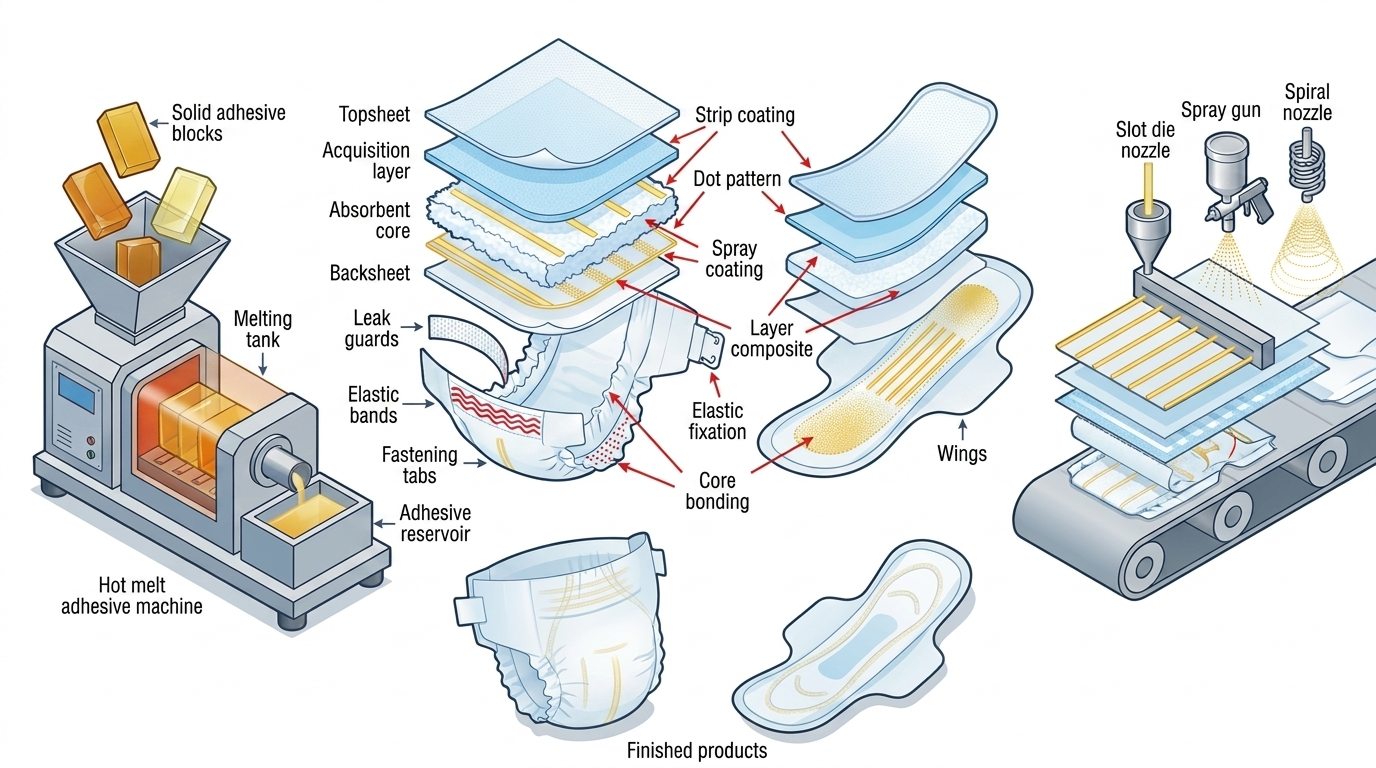
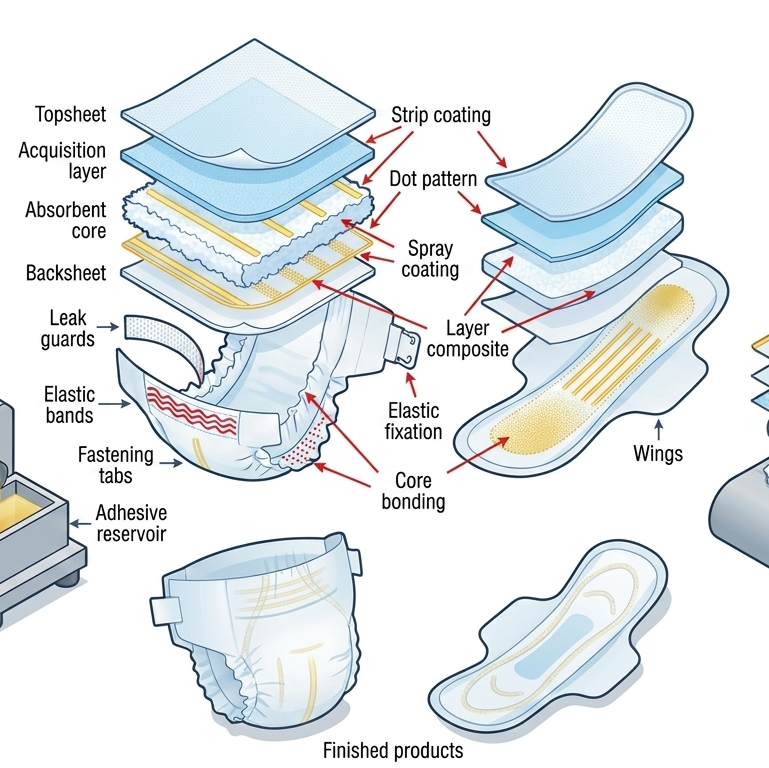
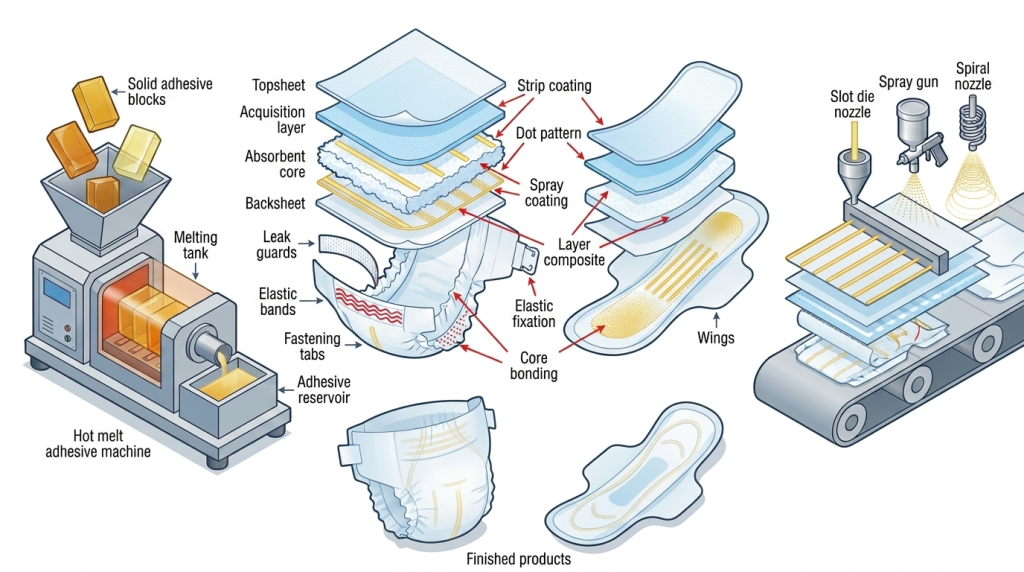
A modern disposable diaper may contain up to seven distinct layers: a liquid-permeable topsheet, an acquisition-distribution layer (ADL), a superabsorbent polymer (SAP) core, a core wrap, backsheet film, a waistband, and leg-cuff elastics. Hot melt adhesive for hygiene products is applied at nearly every interface in this structure — bonding the topsheet to the ADL, laminating the core wrap, attaching the backsheet, and anchoring the elastic strands used in leg cuffs and waistbands.
Sanitary napkins follow a similar multilayer design: a soft-touch cover, an absorbent fluff-pulp or SAP core, a leak-proof polyethylene backsheet, and a release paper over the pressure-sensitive bottom adhesive. Across all these product types, adhesive consumption per unit is small — typically 1–4 grams — but cumulative volumes across a production run of tens of millions of units per month are enormous, making adhesive performance and cost efficiency highly consequential decisions.
The Critical Role of SBC Hot Melt Adhesive in Hygiene Assembly
Styrene block copolymer (SBC) adhesives — formulated from SIS (styrene-isoprene-styrene) or SEPS (styrene-ethylene-propylene-styrene) base polymers — are the dominant chemistry for hot melt adhesive in hygiene products and diapers. Their unique combination of properties makes them the preferred choice over EVA- or polyolefin-based alternatives for most hygiene assembly steps:
- Inherent softness and flexibility at body temperature (approximately 37 °C), ensuring the bond line does not create stiffness or discomfort against the wearer’s skin
- Low application temperature (typically 130–160 °C compared to 160–180 °C for standard EVA), reducing thermal degradation risk and energy consumption
- Excellent compatibility with nonwoven polypropylene (PP) topsheets, PE backsheet films, and spandex/Lycra elastic strands
- Fast set speed to support line speeds above 800 m/min without slippage before bond formation
- Good open time control — formulators can tune open time between 0.5 and 3 seconds depending on whether the adhesive is applied via slot-die coating, spiral spray, or multi-bead application
According to market research by Mordor Intelligence, the global hygiene hot melt adhesive market was valued at approximately USD 1.8 billion in 2024 and is forecast to exceed USD 2.5 billion by 2030, driven by rising diaper penetration in Southeast Asia, India, and Africa. This growth is placing new pressure on adhesive suppliers to offer products that combine performance, skin safety, and supply chain reliability.
Elastic Attachment: One of the Most Demanding Hot Melt Applications
Leg-cuff and waistband elastic attachment is widely regarded as the most technically challenging bonding step in diaper manufacturing. The process involves applying adhesive to either the elastic strand or the substrate while the elastic is stretched to 150–300% of its relaxed length, then bonding it between two nonwoven layers, and finally allowing the elastic to retract — creating the characteristic gathered appearance that provides a leak-resistant fit.
For this application, the adhesive must perform three simultaneous functions: it must wet out and adhere to smooth spandex elastic (a notoriously difficult substrate), maintain cohesive strength during cyclic stretch-relax cycles exceeding 10,000 repetitions, and remain flexible at temperatures down to 5 °C (for cold-climate distribution) without losing bond strength. Devote’s SBC-based elastic attachment adhesives are formulated with tackifier and plasticizer systems optimized for this balance, delivering peel strength values consistently above 3.5 N/25mm on standard spandex-to-nonwoven test specimens.
Skin-Safe Requirements and Toxicological Standards
Because hygiene products come into direct or near-direct skin contact, particularly with infants, adhesive formulations must meet rigorous safety standards. The primary regulatory benchmarks that responsible suppliers — including Devote — apply to hot melt adhesive for hygiene products include:
- EU REACH Regulation (EC 1907/2006) — full compliance with Substances of Very High Concern (SVHC) candidate list restrictions
- OEKO-TEX Standard 100 — third-party certification confirming the adhesive contains no harmful substances that could be transferred to textiles or skin
- FDA 21 CFR guidelines — referenced by many global brands for adhesive components that may contact skin directly or indirectly
- Restricted Substance Lists (RSL) issued by major hygiene brands such as Procter & Gamble, Kimberly-Clark, and Essity — covering phthalates, formaldehyde-releasing agents, bisphenols, and a growing list of intentionally added chemicals
Compliance documentation is not optional — it is a minimum commercial requirement for supplying adhesives to Tier 1 hygiene brands. Devote maintains a full regulatory dossier for each product grade, including Safety Data Sheets (SDS), Declarations of Conformity (DoC), and test reports from accredited third-party laboratories.
High-Speed Production Requirements
Modern diaper and sanitary napkin production lines operate at extraordinary speeds. A high-output diaper line from Zuiko, Fameccanica, or Drylock Technologies may produce 1,200 diapers per minute, meaning each individual bonding event must occur, wet out, and set within a fraction of a second. This imposes strict requirements on adhesive rheology.
Viscosity must be low enough to atomize cleanly through multi-nozzle spiral spray heads or slot-die coaters without fiber formation (stringing), yet high enough to prevent adhesive migration into absorbent core materials. Typical application viscosity for hygiene SBC adhesives falls in the range of 2,000–8,000 mPa·s at 140 °C, depending on the application method and substrate. Adhesive pot life in the hot melt tank must be sufficient for continuous production (typically 72–96 hours at application temperature) without viscosity drift or char formation.
Devote’s hygiene product adhesive grades are evaluated on production-scale hot melt equipment — not just laboratory rheometers — before release, ensuring that lab data translates reliably to real-world line performance. Learn more about our complete range of hot melt adhesive applications across hygiene, filtration, automotive, and packaging industries.
Recommended Devote Products for Hygiene Applications
Devote manufactures a range of SBC-based hot melt adhesives specifically developed for disposable hygiene product assembly. Key product families include:
- Construction Lamination Grade — designed for core wrap lamination, topsheet-to-ADL bonding, and backsheet attachment; low grammage application (1–3 g/m²) with consistent coverage via slot-die
- Elastic Attachment Grade — high green strength SIS/SEPS formula for leg-cuff and waistband elastic; excellent adhesion to spandex strands at stretch ratios up to 300%
- Waistband Tape Grade — pressure-sensitive hot melt for re-closable diaper fastening tabs; balanced between tack and cohesive strength to withstand repeated open-and-close cycles
- Acquisition Layer Bonding Grade — low-viscosity formula for ADL integration; formulated to minimize hydrophilicity disruption of the ADL layer
All Devote hygiene adhesives are manufactured at our ISO 9001-certified facility in Shenzhen, China, with outgoing quality control based on viscosity, softening point, color, and peel strength to ensure batch-to-batch consistency. For a comprehensive overview of adhesive chemistry options, ASTM International’s adhesives standards library (astm.org) provides an authoritative reference on test methods used across the industry.
Frequently Asked Questions
What is the best hot melt adhesive for diaper elastic attachment?
SBC-based hot melt adhesives — particularly those formulated with SIS or SEPS polymers — are the industry standard for diaper elastic attachment. They offer the necessary combination of flexibility, adhesion to spandex substrates, and fast set speed at high production line speeds. Application temperatures typically range from 130 to 155 °C, and application weight is usually 1.5–3 mg per millimeter of elastic strand length. When selecting a grade, confirm compatibility with your specific elastic strand supplier and nonwoven substrate, and request peel strength and stretch-cycle fatigue data.
Do hygiene product adhesives need special certifications?
Yes. Adhesives used in disposable diapers, sanitary napkins, and adult incontinence products must comply with EU REACH SVHC restrictions, and should be evaluated against major brand Restricted Substance Lists (RSLs). OEKO-TEX Standard 100 certification provides third-party validation of skin safety. For products sold in North America, alignment with FDA 21 CFR Component guidelines for indirect food and skin contact substances is commonly expected by Tier 1 customers. Always request current SDS and DoC documents from your adhesive supplier.
How does adhesive selection affect production line efficiency in hygiene manufacturing?
Adhesive viscosity, open time, and thermal stability directly impact uptime and waste on high-speed hygiene lines. An adhesive with excessive viscosity at application temperature causes nozzle blockages and stringing, leading to line stops for cleaning. Insufficient green strength causes bond failures and product rejects before the article reaches the cut-and-stack station. Thermal instability causes char buildup in tanks and hose systems, requiring costly purge cycles. Selecting an adhesive specifically validated for your line speed, application method, and substrate combination — and supported by a supplier with responsive technical service — is the most effective way to protect OEE (Overall Equipment Effectiveness) in hygiene production.
Partner with Devote for Hygiene Adhesive Solutions
Selecting the right hot melt adhesive for hygiene products involves navigating a complex intersection of regulatory compliance, substrate chemistry, equipment parameters, and production economics. Devote’s technical team has supported hygiene manufacturers across Asia, the Middle East, and Europe in qualifying adhesive grades for new product launches and production line upgrades.
Whether you are sourcing adhesives for a new diaper SKU, qualifying a second supplier for supply chain resilience, or troubleshooting bond failures on an existing line, we can provide product samples, technical data sheets, application guidelines, and on-site evaluation support.
Contact Devote today to speak with a hygiene adhesive specialist and request samples for your specific application. Our team typically responds within one business day.