

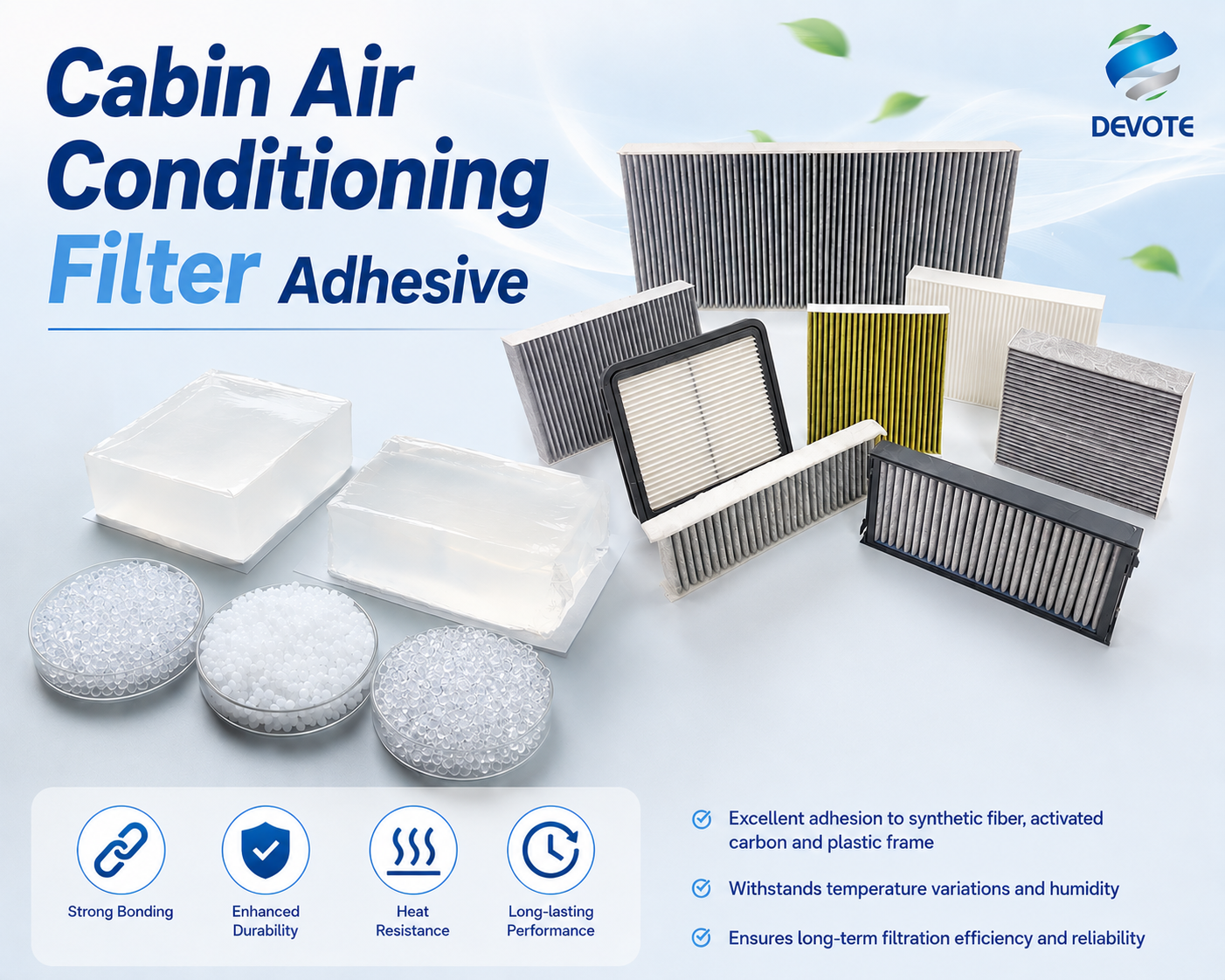
Selecting the right automotive filter adhesive is critical for vehicle safety and filter longevity. Modern engine compartments subject filter assemblies to temperatures exceeding 150 degrees Celsius, continuous vibration, and exposure to oil mist and coolant chemicals. A poorly chosen hot melt adhesive can cause media delamination, end-cap separation, or seal failure. These failures lead to warranty claims and compromised engine protection. The global automotive filter market, valued at approximately USD 24.5 billion in 2023, demands adhesives that meet stringent OEM specifications. This guide covers the performance requirements, chemistry options, and production considerations that filter manufacturers must evaluate.
Types of Automotive Filters That Use Hot Melt Adhesive
Modern vehicles contain four primary filter types, each with distinct bonding requirements. Engine air intake filters use pleated paper or synthetic media bonded to plastic or metal end-caps. These require adhesives with strong substrate adhesion and moderate heat resistance. Oil filters demand the highest chemical resistance, as the adhesive must withstand continuous contact with petroleum-based fluids at elevated temperatures. Fuel filters protect sensitive injection systems and require adhesives compatible with gasoline and diesel. Cabin air filters operate at lower temperatures but need consistent bonding for long service intervals. Manufacturers can explore detailed bonding solutions on our automotive air filter application page.
Key Performance Requirements for Automotive Filter Adhesive
The automotive filter adhesive must satisfy five core performance criteria to meet OEM specifications:
- Heat resistance: Under-hood temperatures regularly reach 120 to 150 degrees Celsius. The adhesive must maintain structural integrity without softening or losing bond strength at these temperatures.
- Vibration resistance: Engine vibration frequencies between 20 and 200 Hz subject filter bonds to continuous mechanical stress. The adhesive must absorb and distribute these forces without fatigue failure.
- Chemical resistance: Oil filters require adhesion that survives prolonged contact with petroleum fluids. Coolant, fuel, and cleaning chemicals also challenge the bond line.
- Substrate compatibility: Filters bond dissimilar materials, including paper media to plastic, metal to rubber, and synthetic fiber to composite end-caps. The adhesive must wet and adhere to all surfaces.
- Service life: Automotive filters typically operate for 15,000 to 30,000 kilometers between replacements. The adhesive must maintain performance throughout this cycle without degradation.
These criteria directly influence chemistry selection. The SAE International standards provide testing protocols that filter manufacturers use to validate adhesive performance under real-world conditions. Independent testing typically includes thermal cycling from minus 40 to 130 degrees Celsius, salt spray exposure for 500 hours, and mechanical vibration at 30 Hz for 96 hours. Adhesives that fail any of these tests are rejected for OEM-grade filter production.
Adhesive Chemistry Comparison for Filter Bonding
Three hot melt adhesive chemistries dominate automotive filter production. Each offers distinct advantages depending on the filter type and operating environment:
| Chemistry | Max Temp | Chemical Resistance | Set Speed | Typical Application |
|---|---|---|---|---|
| EVA | 80 degrees C | Moderate | Fast | Air filter pleat bonding |
| Polyolefin (PO) | 120 degrees C | Good | Medium | Air and cabin filter assembly |
| Polyamide (PA) | 160+ degrees C | Excellent | Medium | Oil and fuel filter end-cap |
EVA (ethylene-vinyl acetate) offers fast set speed and good adhesion to paper media. This makes it suitable for air intake filter pleating. However, its thermal ceiling of approximately 80 degrees Celsius limits use near heat sources. Polyolefin adhesives bridge the gap, withstanding temperatures up to 120 degrees Celsius while providing better chemical resistance than EVA. For oil and fuel filter applications, polyamide adhesives deliver superior heat resistance above 160 degrees Celsius and excellent chemical stability in petroleum environments. Devote’s polyamide hot melt adhesive range is engineered specifically for these demanding conditions.

Temperature Resistance in Automotive Filter Adhesive Systems
Thermal performance is the most frequently underestimated requirement in automotive filter adhesive selection. Engine compartments experience thermal cycling from cold starts at minus 40 degrees to sustained operating temperatures above 120 degrees. The adhesive must expand and contract with the substrate without cracking or losing bond strength. Polyamide adhesives excel in this environment, maintaining modulus and adhesion across a 200-degree operating range. Glass transition temperatures for PA grades typically fall between minus 20 and plus 10 degrees Celsius, providing flexibility at low temperatures and rigidity at high temperatures. For applications near exhaust manifolds or turbochargers, PA chemistry is the only viable option. Manufacturers producing folded paper filter elements can review specific pleat bonding adhesive guidelines on our application page.
Devote Solutions for Automotive Filter Adhesive Applications
Devote, based in Shenzhen, China, manufactures a comprehensive range of hot melt adhesives engineered for automotive filter production. Key products include:
- Devote 3031BQ: Designed for air filter pleat bonding, offering fast set time and excellent adhesion to paper and synthetic media.
- Devote 8082H: A fast-curing EVA adhesive with 1 to 3 second set speed for high-speed production lines.
- PA high-temperature grades: Formulated for oil and fuel filter end-cap bonding with thermal stability above 160 degrees Celsius.
All Devote adhesives are produced under ISO 9001 quality management systems. The company holds IATF 16949 certification for automotive supply chain compliance, ensuring full lot traceability and consistent batch quality. Devote also maintains REACH and RoHS compliance documentation for all automotive-grade products, supporting European market access. Production capacity exceeds 500 metric tons per month, enabling stable supply for high-volume filter manufacturing operations. Learn more about our company on the About Devote page. For oil and fuel filter bonding applications, visit our oil and fuel filter application page.
Production Line Considerations for Filter Manufacturers
Beyond chemistry selection, production efficiency depends on adhesive application parameters. Viscosity determines nozzle and equipment compatibility. Low-viscosity grades below 5,000 mPas at 180 degrees suit spiral spray and slot-die coating for pleat bonding. Higher-viscosity grades above 10,000 mPas provide better gap-filling for end-cap bonding. Open time must match the production line speed. High-speed filter lines running 60 to 120 units per minute require adhesives with 1 to 3 second open times. Slower assembly operations benefit from longer open times of 5 to 10 seconds. Manufacturers should maintain adhesive temperature control within plus or minus 5 degrees to ensure consistent bead profile and bond quality. Regular maintenance of melt tanks and nozzles prevents charring and carbonization, which degrade adhesive performance over extended production runs. Our filter manufacturing application page provides additional production guidance.
Frequently Asked Questions
What temperature range can hot melt adhesive withstand in automotive filters?
EVA-based adhesives perform reliably up to 80 degrees Celsius, making them suitable for air intake and cabin filters. Polyolefin adhesives extend this range to 120 degrees. For oil and fuel filters operating near engine heat sources, polyamide adhesives maintain performance above 160 degrees Celsius. Always verify the specific grade’s thermal limit against the filter’s maximum operating temperature.
Which adhesive chemistry is best for oil filter end-cap bonding?
Polyamide adhesive is the preferred chemistry for oil filter end-cap bonding. It combines high-temperature resistance with excellent resistance to petroleum-based fluids. PA adhesives maintain bond strength during prolonged oil immersion at elevated temperatures. EVA and PO grades may soften or degrade under the same conditions, making them unsuitable for oil filter applications.
How does vibration affect adhesive performance in automotive filters?
Engine vibration creates cyclic stress on the adhesive bond line. Flexible adhesive chemistries like polyolefin absorb vibration energy effectively, reducing fatigue failure risk. Rigid adhesives may crack under sustained vibration if the bond line is too thin. Filter manufacturers should specify adhesives with adequate flexibility and apply sufficient bond thickness to distribute mechanical loads across the joint.
Choosing the right automotive filter adhesive directly impacts product safety, warranty costs, and brand reputation. Devote combines ISO 9001 and IATF 16949 certified manufacturing with deep application expertise to deliver adhesive solutions that meet the most demanding automotive specifications. Contact our team to discuss your filter bonding requirements.

