

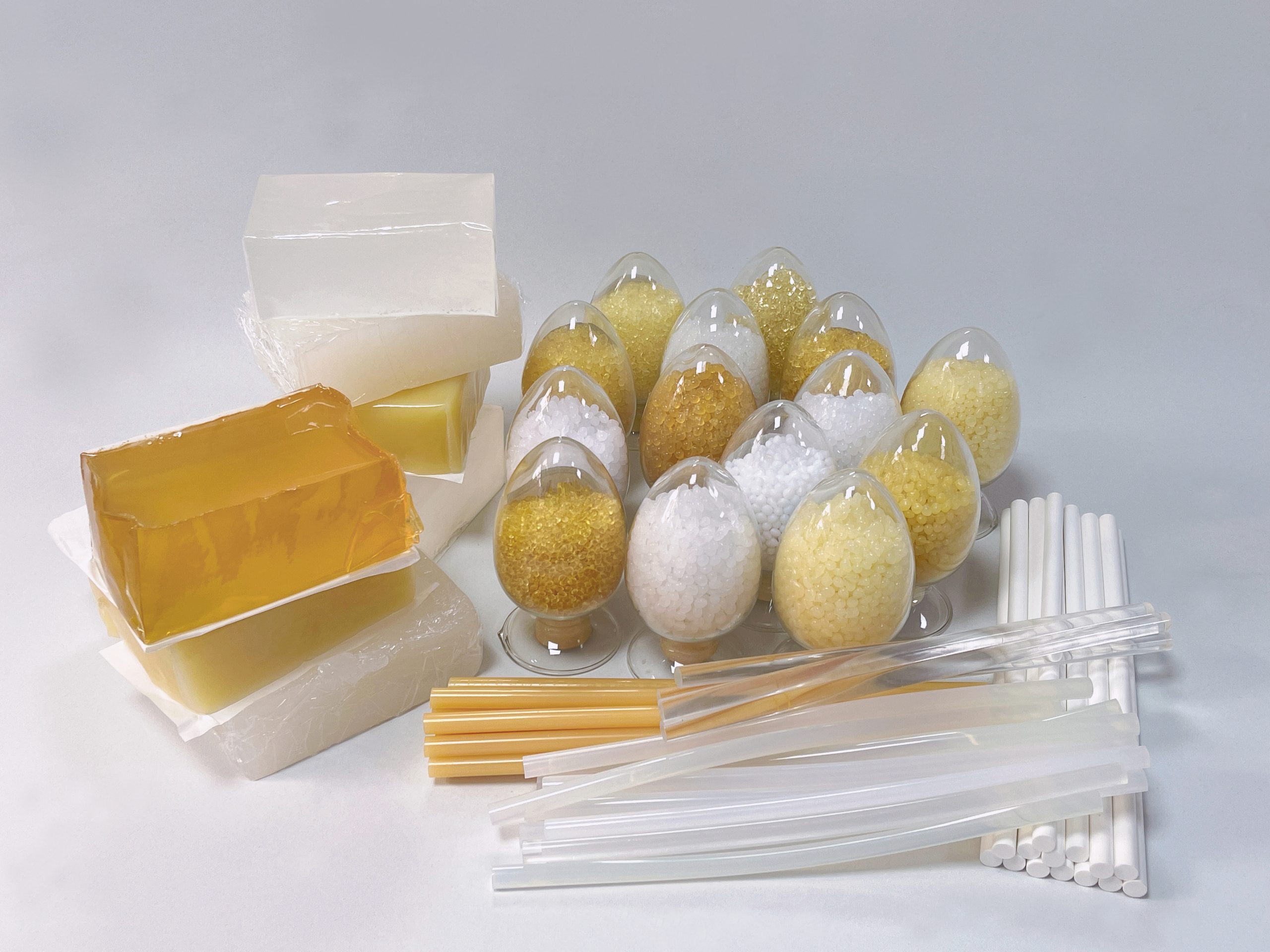
When comparing EVA vs PO adhesive for industrial manufacturing, the choice between ethylene-vinyl acetate and polyolefin chemistry is critical. This decision impacts bond strength, thermal stability, and production cost. Both hot melt adhesive families command over 60% of the global market share. Yet they serve fundamentally different bonding applications. This guide breaks down performance, cost, and application fit to help you select the right grade.
EVA Hot Melt Adhesive Overview
Ethylene-vinyl acetate (EVA) copolymers are the workhorse of the hot melt adhesive world. First commercialized in the 1960s, EVA adhesives typically contain 18 to 40 percent vinyl acetate by weight. The vinyl acetate content controls flexibility, transparency, and tack: higher VA content yields softer, stickier formulations.
Key characteristics of EVA hot melt adhesives include:
- Application temperature: 150 to 180 degrees Celsius
- Viscosity range: 1,000 to 30,000 mPa·s at 180 degrees Celsius
- Open time: 2 to 10 seconds for fast setting
- Softening point: 80 to 100 degrees Celsius
- Material cost: 17 to 19 CNY per kg FOB Shenzhen
EVA excels in high-speed packaging, bookbinding, and product assembly where rapid set times matter. Devote manufactures a dedicated EVA hot melt adhesive line. Key grades include 8082W for PO sealing and 9172A for PET labeling. These perform at line speeds exceeding 60,000 bottles per hour.
Polyolefin (PO) Hot Melt Adhesive Overview
Polyolefin hot melt adhesives are formulated from metallocene-catalyzed polyethylene or amorphous polyolefin resins. Unlike EVA, PO adhesives contain no vinyl acetate, offering superior thermal stability and resistance to grease, oil, and moisture.
Key characteristics of PO hot melt adhesives:
- Application temperature: 160 to 200 degrees Celsius
- Viscosity range: 2,000 to 20,000 mPa·s at 180 degrees Celsius
- Open time: 5 to 30 seconds, adjustable by formulation
- Softening point: 110 to 155 degrees Celsius
- Material cost: 19 to 26 CNY per kg FOB Shenzhen
PO adhesives bond exceptionally well to polypropylene, polyethylene, and other low-energy surfaces where EVA struggles. This makes them the preferred choice for hygiene products, automotive trim, and filtration. Devote supplies polyolefin hot melt adhesive grades to filter manufacturers across Asia and Europe. Devote 3031BQ is specifically engineered for air filter pleat-line bonding.
EVA vs PO Adhesive: Performance Comparison
Understanding the performance differences between EVA vs PO adhesive systems helps manufacturers match adhesive chemistry to production requirements. The table below summarizes critical parameters:
| Property | EVA Hot Melt | PO Hot Melt |
|---|---|---|
| Service temp (max) | 70 to 80 degrees C | 120 to 140 degrees C |
| Heat resistance | Moderate | High |
| Cold resistance | Brittle below -20 degrees C | Flexible to -30 degrees C |
| Substrate adhesion | Paper, wood, metal | PP, PE, low-energy surfaces |
| Aging stability | Moderate, prone to oxidation | Excellent |
| Color stability | Good | Excellent |
| Moisture resistance | Moderate | High |
| Set speed | Fast, 2 to 5 seconds | Slower, 5 to 15 seconds |
PO adhesives deliver approximately 40 to 60 percent higher heat resistance than EVA. This makes them essential for applications involving sustained elevated temperatures. In filtration, pleated media must endure thermal cycling from -40 to 120 degrees Celsius. PO formulations maintain bond integrity where EVA would degrade. EVA wins on set speed. In high-speed packaging lines running 200 to 500 cartons per minute, EVA’s 2 to 5 second set time prevents flap pop-open. Slower-setting PO adhesives may allow this defect.
Cost Analysis: EVA vs PO Adhesive Economics
The cost gap between EVA vs PO adhesive families is meaningful but must be evaluated against total cost of ownership:
- Material cost: PO adhesives cost 20 to 40 percent more per kilogram than EVA equivalents
- Application efficiency: PO’s longer open time allows more precise placement, reducing adhesive waste by 5 to 15 percent
- Failure cost: In thermal cycling applications, EVA bond failure can trigger product returns costing 10 to 50 times the adhesive savings
- Equipment compatibility: Both chemistries apply on standard slot-die, spiral, and bead equipment without modification
For packaging operations where service temperature stays below 70 degrees Celsius, EVA remains the most economical choice. For applications requiring thermal stability, chemical resistance, or polyolefin substrates, PO is preferred. Its higher unit cost is offset by superior long-term performance and reduced failure rates.

Application Selection Guide
Different industries favor different adhesive families based on their specific requirements. Use the following criteria to guide your initial selection.
When to Choose EVA
- Carton and case sealing at line speeds above 100 units per minute
- Bookbinding and paper converting
- Woodworking and furniture assembly
- PET bottle labeling at high speeds
- General product assembly under 70 degrees Celsius service temperature
When to Choose PO
- Air and liquid filter manufacturing
- Hygiene products including diapers and sanitary napkins
- Automotive interior trim bonding
- Polypropylene and polyethylene assembly
- Applications with service temperatures above 80 degrees Celsius
- Outdoor or weather-exposed products
Devote serves customers across all these application areas from its ISO 9001 certified facility in Shenzhen. The company offers both EVA and PO grades tailored to specific production requirements. Expertise spans packaging and filter manufacturing applications.
EVA vs PO Adhesive: Selection Recommendation
Selecting the right hot melt adhesive comes down to four decision criteria:
- Service temperature: Above 80 degrees Celsius, choose PO. Below this threshold, either chemistry works.
- Substrate type: For polypropylene or polyethylene, PO is required. For paper and wood, EVA is preferred.
- Line speed: For set times under 5 seconds, EVA typically performs better. PO formulations with fast-set modifiers are available but at premium cost.
- Environmental exposure: For outdoor or high-moisture applications, PO provides superior durability.
When in doubt, request samples of both adhesive families. Conduct bond tests on your actual substrates at production temperatures. Devote provides free sample shipments under 50 kg via express courier for qualification testing. The global hot melt adhesive market was valued at USD 9.5 billion in 2024. It projects a 5.2 percent CAGR through 2030. The market continues to shift toward polyolefin formulations in high-performance applications. EVA maintains dominance in high-volume packaging.
According to the Adhesive and Sealant Council, both chemistries will continue to coexist. No single formulation meets every industrial bonding requirement. Manufacturers who understand the EVA vs PO adhesive tradeoff can optimize performance and cost. Learn more about Devote and our commitment to adhesive innovation.
Frequently Asked Questions
Which is cheaper, EVA or polyolefin hot melt adhesive?
EVA prices range from 17 to 19 CNY per kg. PO grades run 19 to 26 CNY per kg FOB Shenzhen. However, PO’s superior thermal stability and broader substrate compatibility can reduce total cost of ownership in demanding applications.
Can EVA adhesive bond to polypropylene surfaces?
Standard EVA hot melt adhesives achieve only marginal adhesion to untreated polypropylene. For reliable PP bonding, polyolefin-based adhesives are strongly recommended. If EVA must be used, surface treatment can help. Corona discharge or flame treatment can improve bond strength by 40 to 60 percent.
What temperature range does polyolefin hot melt adhesive withstand?
Polyolefin hot melt adhesives maintain bond integrity from -30 to 140 degrees Celsius depending on formulation. This broad thermal window suits automotive under-hood components, HVAC filter assemblies, and outdoor products. EVA’s 70 to 80 degree upper limit would cause failure in these applications.
Contact Devote for Expert Adhesive Selection
Still uncertain whether EVA or PO is right for your application? Devote’s technical team in Shenzhen provides free consultation and material recommendations. We also offer rapid sample delivery to help you decide. With ISO 9001 and IATF 16949 certifications, Devote supplies manufacturers worldwide across filtration, packaging, automotive, and hygiene industries.

