

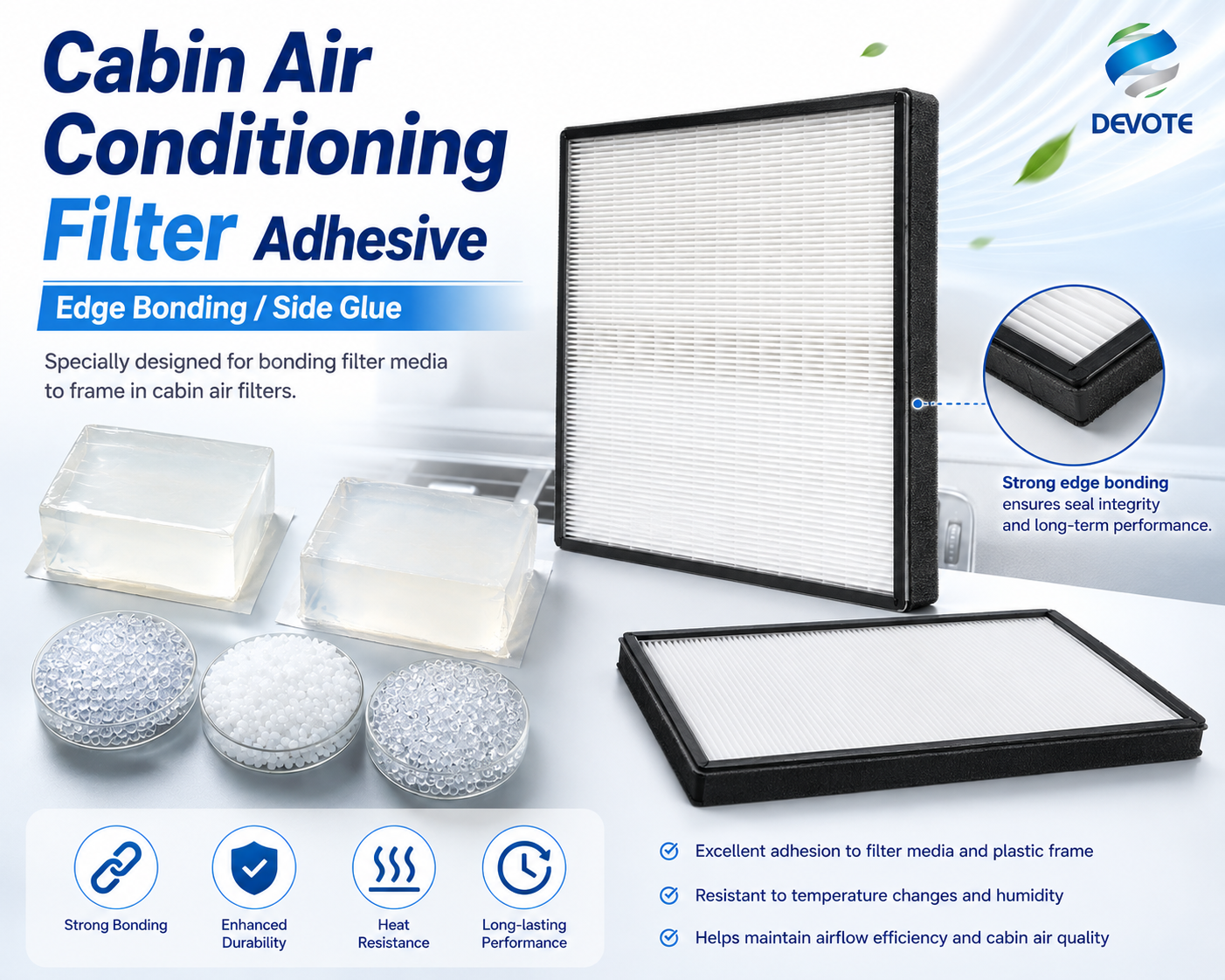
Selecting the right air conditioning filter adhesive is essential for manufacturers who want reliable HVAC performance and clean production lines. Air conditioning filters operate in demanding conditions: repeated thermal cycling, high humidity, and constant airflow across pleated media. The adhesive must bond non-woven fabric, paper, or synthetic media to plastic or metal frames without blocking airflow or releasing odors. With global HVAC filter demand growing at 6.2 percent CAGR and reaching an estimated USD 12.8 billion by 2028, material selection directly affects warranty risk and brand reputation. This guide explains how to evaluate adhesives for AC filter assembly, from construction details to application parameters.
How Air Conditioning Filter Adhesive Fits Into Filter Construction
Most residential and automotive AC filters share a similar layered structure. A rigid frame, usually ABS plastic or galvanized metal, holds a continuous sheet of pleated filter media. Pleats increase surface area and are typically spaced 4 to 8 millimeters apart. Adhesive is applied along the pleat edges, where media meets the frame, and sometimes across separator beads to maintain pleat spacing. Automotive cabin filters add an additional challenge because engine-bay temperatures can reach 80 to 120 degrees Celsius, depending on vehicle design and climate. For a closer look at dedicated automotive grades, see our automotive air conditioning filter adhesive page. Understanding these bond lines is the first step in choosing an adhesive with the right open time, viscosity, and heat resistance.
Key Performance Requirements for Air Conditioning Filter Adhesive
A suitable AC filter adhesive must satisfy five performance criteria. First, it needs fast setting speed. Automated pleating and framing lines often run at 20 to 60 meters per minute, so slow-setting adhesives cause misalignment. Second, it must maintain adhesion to low-surface-energy plastics such as polypropylene and ABS. Third, the bond must remain flexible across a wide temperature window. Thermal expansion should not crack adhesive joints during summer heat or winter cold. Fourth, the formulation should be low-odor and low-VOC. Cabin filters sit inside vehicle and building ventilation systems, so outgassing is unacceptable. Fifth, the adhesive must resist moisture and mold growth common in humid climates. Our HEPA filter adhesive solutions portfolio includes grades specifically tested for these HVAC conditions.
| Requirement | Typical Target | Why It Matters |
|---|---|---|
| Bond speed | 1 to 5 seconds set time | Matches high-speed pleating lines |
| Temperature range | -40C to +120C | Covers cabin and outdoor units |
| Substrate adhesion | PP, ABS, PET, paper | Prevents frame separation |
| Viscosity | 1,500 to 5,000 mPas at 160C | Compatible with slot-die and bead nozzles |
| Odor / VOC | Low-odor, RoHS compliant | Safe for indoor and cabin use |

Temperature Range and Environmental Stress
Temperature is the most common reason AC filter bonds fail. In automotive applications, a filter mounted behind the dashboard experiences summer heat soak above 85 degrees Celsius. In contrast, filters for outdoor condenser coils may face winter lows below minus 30 degrees Celsius in cold-climate markets. EVA-based hot melts are economical and bond well to paper, but their heat resistance typically tops out around 70 to 80 degrees Celsius. Polyolefin grades extend this range to approximately 100 to 120 degrees Celsius while maintaining good adhesion to polypropylene. For extreme under-hood zones, polyamide formulations can withstand peak temperatures above 130 degrees Celsius. Devote’s car air conditioning filter edge bonding grade is formulated for these exact edge-bonding conditions.
Product Recommendations by Filter Type
Different AC filter constructions favor different adhesive chemistries. Standard cabin air filters with paper media and plastic frames perform well with premium EVA grades that offer balanced adhesion and low cost. Synthetic media filters, often made from melt-blown polypropylene, bond better with polyolefin adhesives because the chemistry matches the substrate. High-efficiency HEPA units used in commercial buildings require low-outgassing adhesives that will not degrade fine fiber performance over time. Washable and reusable filters introduce another variable: the adhesive must survive occasional rinsing without losing bond strength. Our filter manufacturing process overview explains how these choices fit into a full production workflow.
| Filter Type | Recommended Chemistry | Key Benefit |
|---|---|---|
| Paper cabin filters | EVA hot melt | Cost-effective, fast set, good paper bond |
| Synthetic PP media | Polyolefin hot melt | Compatible with low-surface-energy plastics |
| High-temp automotive | Polyamide / PO blend | Resists heat soak and thermal cycling |
| HEPA commercial units | Low-VOC EVA or PO | Minimal outgassing, stable long-term bond |
Application Tips for Consistent Results
Even the best adhesive will underperform if application parameters are wrong. Start by setting the tank temperature within the supplier’s recommended range, usually 150 to 180 degrees Celsius. Excessive heat causes oxidation and char. This clogs nozzles and creates dark specks on white filter media. Check the open time against line speed. If the adhesive skins over before the frame is pressed into place, the bond will be weak. Keep adhesive reservoirs covered. Use first-in-first-out inventory management to avoid aged material. Finally, run peel tests on sample bonds after 24 hours. Repeat the test after a thermal cycle from minus 20 to plus 80 degrees Celsius. ASHRAE publishes widely referenced standards for filter performance and testing at ASHRAE.
Frequently Asked Questions
Can I use a standard packaging adhesive for AC filter assembly?
Standard packaging adhesives are usually too soft and low-temperature for HVAC duty. They may creep in summer heat or lose adhesion on polypropylene frames. Choose a grade formulated for filter manufacturing with documented temperature resistance and substrate compatibility.
What viscosity is best for pleating lines?
Most AC filter lines run adhesives between 1,500 and 5,000 mPas at 160 degrees Celsius. Lower viscosity works well for fine bead application, while higher viscosity reduces stringing on spiral-spray systems. Match the viscosity to your nozzle type and application weight target.
How do I verify bond durability before full production?
Run a three-step validation: first, measure immediate adhesion and fiber tear on representative substrates. Second, age samples at 85 degrees Celsius and 85 percent relative humidity for 168 hours. Third, subject bonded assemblies to thermal shock cycles. If the bond retains over 80 percent of its initial strength, the adhesive is suitable for most HVAC applications.
Get the Right Adhesive for Your AC Filter Line
Choosing the right air conditioning filter adhesive means balancing bond speed, temperature resistance, substrate compatibility, and low-VOC requirements. Start by mapping your filter construction and operating environment, then test candidates under real production conditions. About Devote is an ISO 9001 certified manufacturer in Shenzhen, supplying EVA, PO, PA, and PSA hot melt adhesives to filtration, automotive, and HVAC customers worldwide. If you need samples, TDS, or formulation advice, contact our technical team today.

