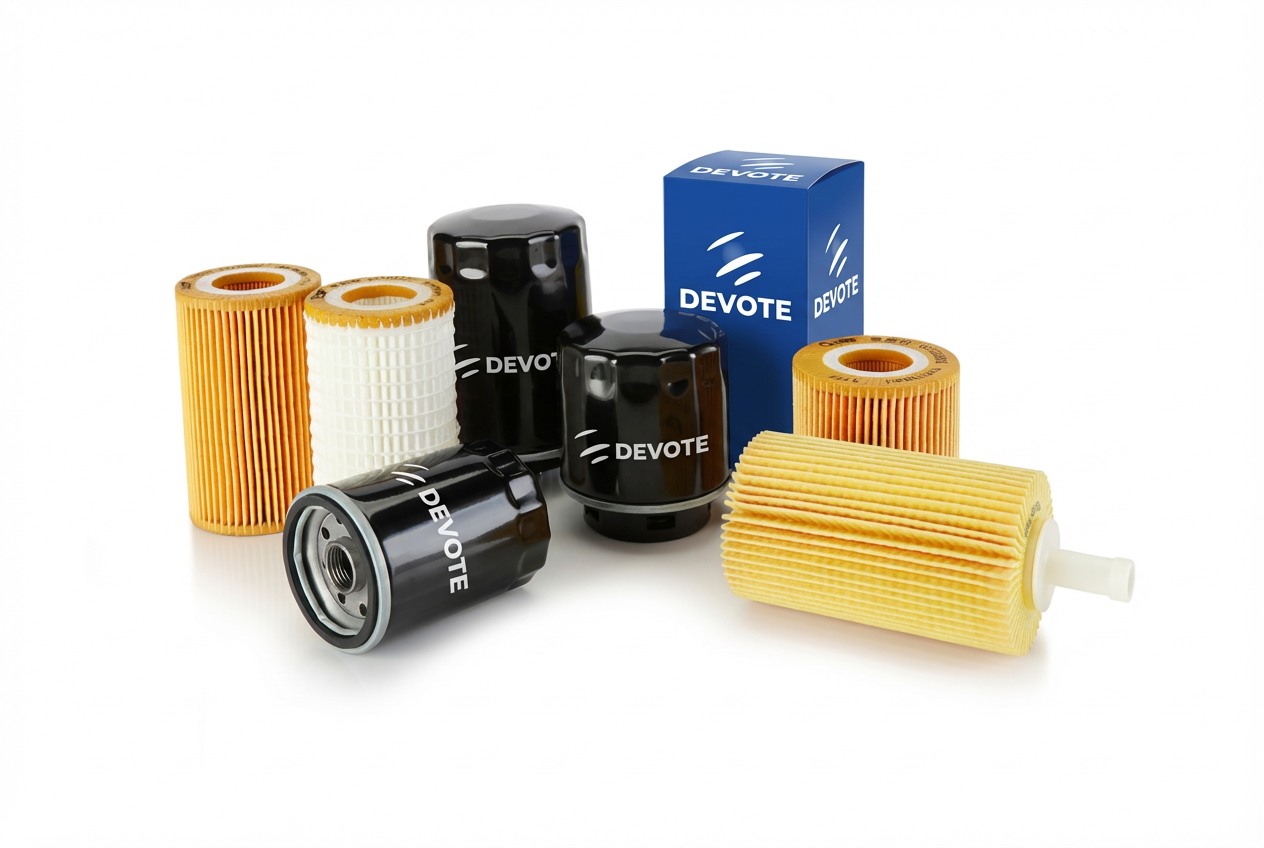
Hot Melt Adhesive for Automotive Filters: Performance Requirements and Solutions
Hot melt adhesive for automotive filters must endure some of the harshest conditions found in any bonding application — temperatures exceeding 120°C under the hood, continuous mechanical vibration, oil mist, coolant splash, and the need to maintain a reliable seal across the entire service life of the vehicle. Selecting the wrong adhesive chemistry can result in filter delamination, media separation, or end-cap failure, each of which carries serious safety and warranty implications. This guide explains exactly what performance criteria matter, compares the leading adhesive chemistries, and shows how Devote’s product range meets OEM-grade requirements.
Types of Automotive Filters That Rely on Hot Melt Adhesive
Modern vehicles contain multiple filter assemblies, and hot melt adhesive plays a structural role in nearly all of them:
- Engine oil filters — Bond pleated cellulose or synthetic media to metal end caps and center tubes. Adhesive must resist engine oil and maintain adhesion from −30°C cold starts to 150°C steady-state oil temperatures.
- Cabin air filters (HVAC) — Seal filter media into plastic frames. Operating temperatures are moderate (−20°C to 80°C), but the adhesive must be low-odor to avoid off-gassing into the passenger compartment.
- Fuel filters — Require excellent resistance to petrol, diesel, and ethanol blends. Adhesive failure here is a safety-critical event.
- Air intake filters — High airflow creates pressure differentials across pleated media. Adhesive bead placement along pleat tips prevents collapse and maintains filter efficiency (MERV/ISO ePM ratings).
- Transmission and hydraulic filters — Continuous submersion in ATF or hydraulic oil at temperatures up to 130°C demands adhesives with outstanding chemical resistance.
Each filter type imposes its own thermal profile, chemical environment, and mechanical stress pattern. A single adhesive grade rarely covers all five categories — understanding the differences is the first step toward a specification that works.
Key Performance Requirements for Hot Melt Adhesive in Automotive Filter Bonding
Automotive filter adhesives are benchmarked against a set of performance parameters that go well beyond standard packaging or woodworking bonding:
| Performance Parameter | Typical Requirement | Test Standard |
|---|---|---|
| Heat resistance (continuous) | 120°C – 150°C | ISO 11357 / SAE J806 |
| Low-temperature flexibility | No cracking at −30°C | SAE J843 |
| Chemical resistance | No softening in engine oil, ATF, diesel | 72-hour immersion test |
| Vibration fatigue resistance | Pass 200-hour road simulation | DIN 76-3 / OEM specs |
| Odor / VOC emission | VDA 270 Class ≤3 (cabin filters) | VDA 270 |
| Open time | 8 – 20 seconds (automated lines) | Internal production spec |
| Viscosity at application temperature | 1,500 – 8,000 mPa·s | Brookfield RVT |
Meeting these requirements is non-trivial. Industry data from ASTM and SAE technical papers show that approximately 18% of field filter failures are attributable to adhesive bond degradation rather than filter media exhaustion — a figure that translates directly into warranty costs for Tier 1 filter manufacturers.
Comparing EVA, PO, and PA Hot Melt Adhesives for Automotive Filters
Three adhesive chemistries dominate the automotive filter sector. Each brings a distinct set of trade-offs:
EVA (Ethylene-Vinyl Acetate) — Standard Grade
EVA hot melt adhesives are the most widely used and the most cost-effective option. Application temperature typically ranges from 150°C to 180°C, and they offer reliable bonding to paper, non-woven fabric, and many plastic frames. However, EVA softens at temperatures above 100°C and is susceptible to swelling in aromatic hydrocarbon environments. For cabin air filters and low-temperature air intake filters, EVA can be an appropriate and economical choice — but it is not recommended for oil or fuel filter applications where chemical exposure is continuous.
PO (Polyolefin) — Mid-Range Performance
Polyolefin hot melts offer a significant step up from EVA in both thermal stability and chemical resistance. PO adhesives maintain structural integrity up to 130°C and show minimal swelling in engine oil and ATF. Their low VOC profile and absence of vinyl acetate monomer also make them preferred for cabin air filter bonding where VDA 270 odor compliance is required. PO adhesives typically process at 160°C to 200°C, requiring equipment capable of reaching and sustaining higher tank temperatures.
PA (Polyamide) — High-Temperature Specialist
For oil filters, fuel filters, and transmission filters where continuous operating temperatures exceed 120°C, polyamide hot melt adhesives are the engineering-grade solution. PA adhesives withstand continuous service temperatures of 150°C or higher, exhibit outstanding resistance to petroleum-based fluids, and maintain bond strength after hundreds of thermal cycles from cold start to operating temperature. The trade-off is cost — PA adhesives are typically 40–60% more expensive than EVA grades — and a higher application temperature of 190°C to 230°C. Processing also requires moisture-controlled storage, as polyamide is hygroscopic.
Case Study: End-Cap Bonding on Pleated Oil Filter Media
A filtration manufacturer producing OEM replacement oil filters for passenger vehicles was experiencing intermittent end-cap separation after extended thermal cycling tests (SAE J806, 1,000 cycles). The original specification used an EVA formulation. After analysis, the failure mode was identified as adhesive creep at high temperature — the EVA softening point was insufficient for the +140°C peak encountered during dyno testing.
Devote supplied a PA hot melt adhesive (application temperature 210°C, heat resistance to 155°C continuous) formulated for metal-to-paper bonding. The revised assembly passed the full SAE J806 protocol with zero failures. Application weight was reduced from 4.2 g/filter to 3.6 g/filter due to the superior wetting of PA adhesive on the fiber matrix, producing a secondary cost saving that offset approximately 30% of the adhesive price premium.
Devote Automotive Filter Adhesive Product Line
Devote, headquartered in Shenzhen, China, manufactures a range of hot melt adhesives engineered specifically for filter bonding across automotive and industrial applications. All products are produced under ISO 9001 quality management and are formulated without restricted substances under REACH and RoHS regulations:
- DV-EVA-F Series — For cabin air filters and low-temperature air intake filters. VOC-compliant, VDA 270 Class 2. Application temperature: 150–175°C.
- DV-PO-A Series — For air intake and HVAC filters requiring higher thermal resistance. Application temperature: 165–200°C. Heat resistance to 130°C continuous.
- DV-PA-H Series — For oil, fuel, and transmission filters. Continuous service to 155°C. Outstanding oil and chemical resistance. Application temperature: 200–225°C.
Custom viscosity grades and open time profiles are available for both high-speed automated lines (up to 300 units/minute) and manual assembly operations. Learn more about our application-specific adhesive solutions or contact our technical team for free sample kits and specification support.
Frequently Asked Questions
Q1: What is the best hot melt adhesive for engine oil filter end-cap bonding?
Polyamide (PA) hot melt adhesive is the recommended choice for engine oil filter end-cap bonding. PA formulations maintain structural integrity at continuous temperatures up to 155°C, resist petroleum-based fluids, and survive thermal cycling from cold start conditions to peak operating temperatures. EVA adhesives are not suitable for this application due to insufficient heat resistance and potential for creep failure above 100°C.
Q2: Can polyolefin hot melt adhesive be used for cabin air filter frames?
Yes. Polyolefin (PO) hot melt adhesive is well-suited for cabin air filter frame bonding. Its low VOC emission profile supports VDA 270 odor class compliance, which is required for components that affect in-cabin air quality. PO adhesives also offer better heat resistance than EVA while remaining cost-effective for moderate-temperature applications up to 130°C.
Q3: How does vibration resistance affect hot melt adhesive selection for automotive filters?
Automotive filters are subjected to continuous road vibration throughout the vehicle’s service life. An adhesive that passes initial bond strength tests may still fail under fatigue loading if its formulation is too brittle. Flexible PO and PA adhesives with controlled shore hardness (Shore A 60–80) typically outperform rigid EVA grades in vibration fatigue tests. Devote’s automotive-grade formulations are benchmarked against OEM road simulation profiles to ensure long-term durability.
Ready to Upgrade Your Automotive Filter Adhesive?
Whether you are qualifying a new adhesive for oil filter production, reformulating cabin air filter assemblies to meet VDA 270 requirements, or looking to reduce material cost through application weight optimization, Devote’s technical team is ready to help. We supply hot melt adhesives to filter manufacturers across Europe, Southeast Asia, and the Middle East, with lead times as short as 15 days for standard grades.
Contact Devote today to request a technical datasheet, free sample, or to discuss a custom formulation for your specific filter assembly process. Our engineers have hands-on experience with both slot-die and bead application systems and can advise on equipment settings as well as adhesive chemistry.
For further reading on filter bonding standards, refer to the ISO 11357 thermal analysis standard, which underpins heat resistance characterization for adhesive materials used in automotive components.