
Our Granule Hot Melt Adhesive Production Process
We manufacture high-quality granule hot melt adhesives (HMAs) using a precise, controlled process designed for consistency, purity, and optimal performance in automated application systems. Here’s a concise overview:
- Raw Material Selection & Quality Control:
- We source premium base polymers (EVA, APAO, Polyolefins, SBCs), tackifying resins (hydrocarbon, rosin esters), waxes, plasticizers, stabilizers (antioxidants), and specialty additives.
- All materials undergo stringent incoming inspection and testing to verify specifications before use. Storage conditions (temperature, humidity) are controlled.
- Precision Weighing & Pre-Mixing:
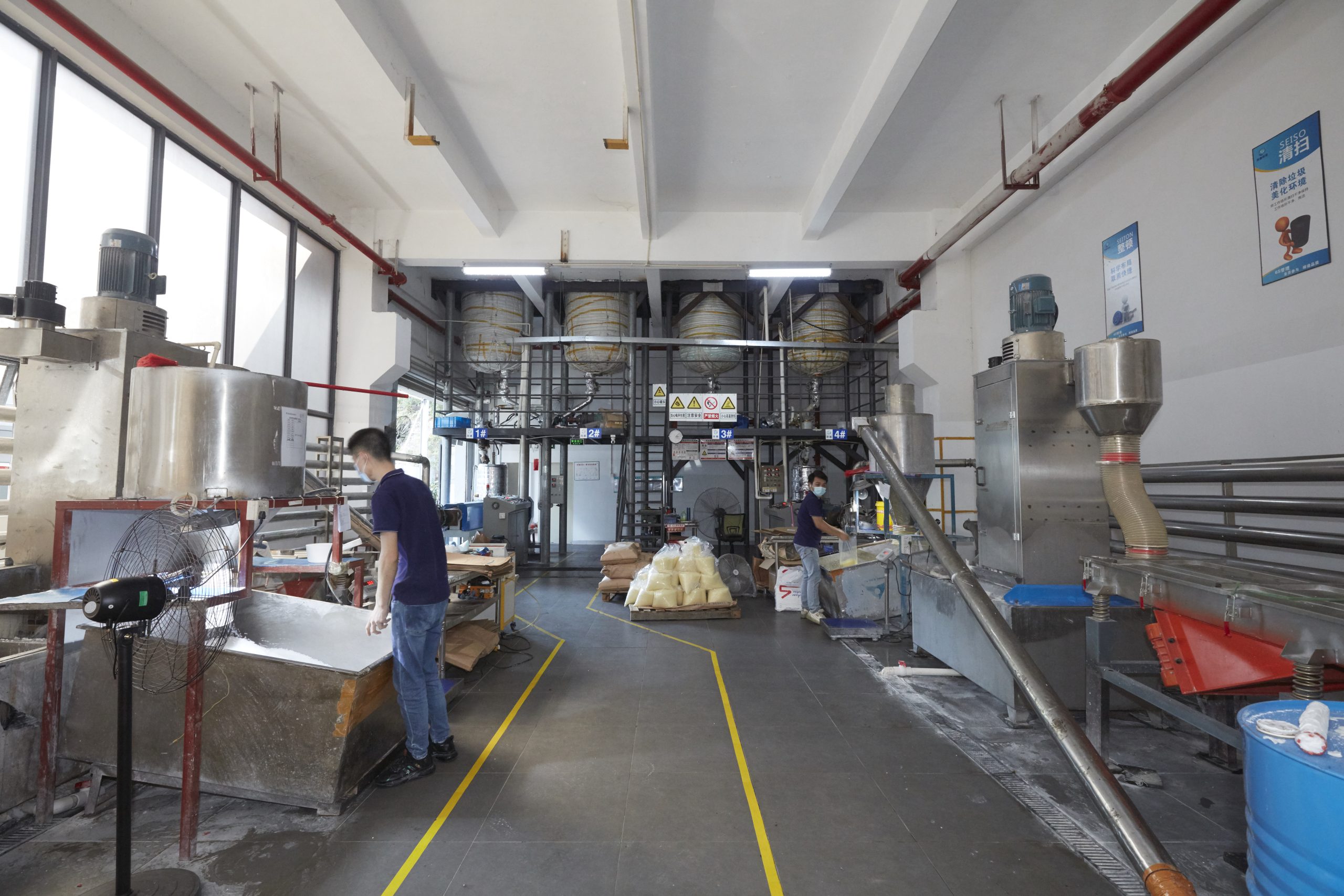
- Ingredients are accurately weighed using automated systems according to the specific formulation.
- Solid components may be dry-blended in controlled batches to ensure uniform distribution before melting.
- Controlled Melting & Homogenization:
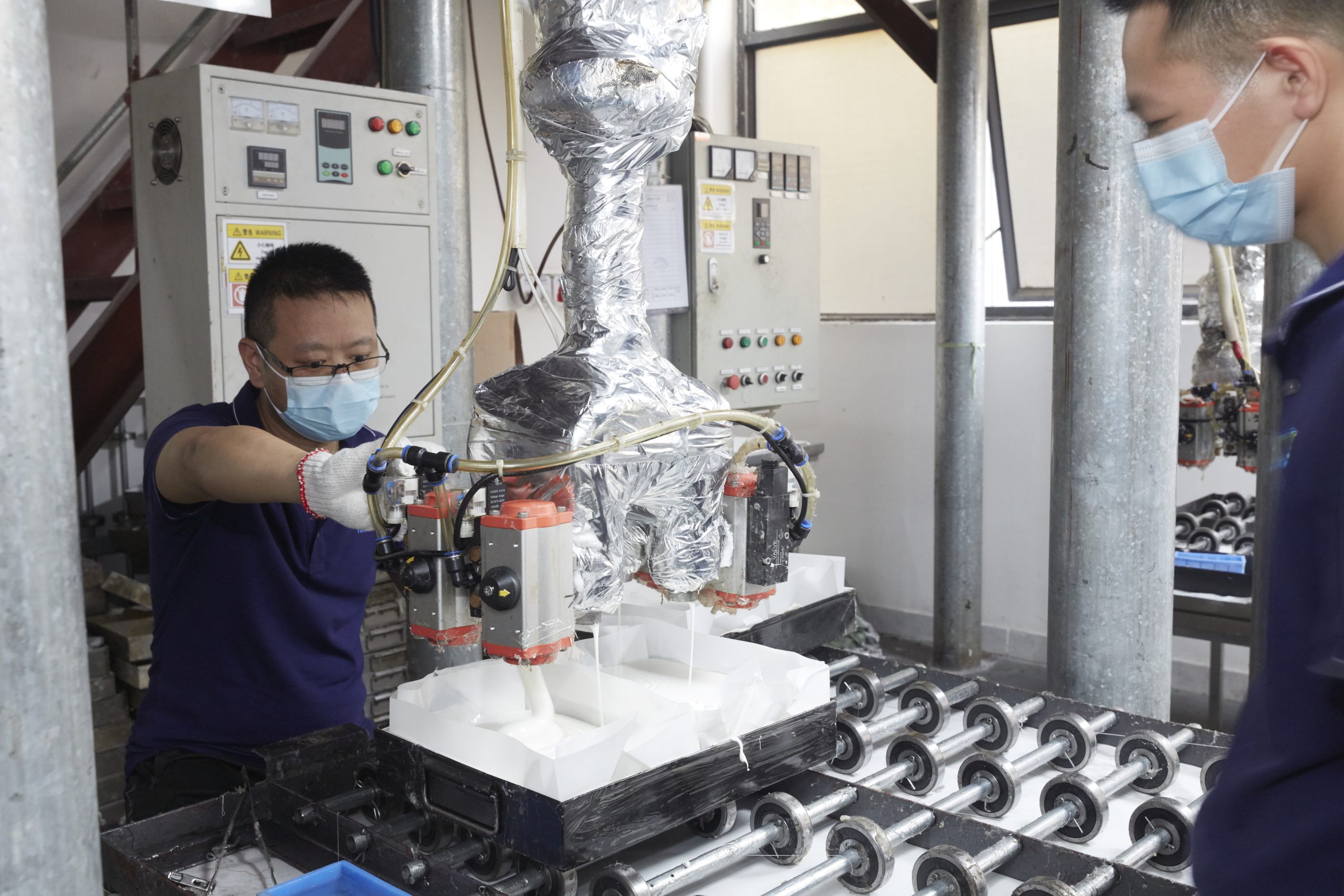
- The pre-weighed materials are fed into primary melt equipment (typically high-screw-count twin-screw extruders or specialized melt mixers).
- Heat (typically 120°C – 180°C) is applied under controlled conditions, often with an inert gas (Nitrogen) blanket, to melt components and prevent oxidation/degradation.
- Intense shear mixing within the extruder/mixer ensures complete dispersion and molecular-level homogenization of polymers, resins, waxes, and additives, achieving target adhesive properties (viscosity, tack, adhesion).
- Filtration:
- The molten adhesive passes through high-precision filtration systems (e.g., screen packs, continuous screen changers) to remove any minute impurities or gel particles, guaranteeing product purity essential for spray applicators.
- Underwater Pelletizing (Core Granule Formation Stage):
- The purified, homogeneous melt is pumped under precise pressure to a die head.
- The melt is extruded through a multi-hole die plate, forming continuous strands or directly cut at the die face into molten droplets.
- Immediate Quenching: The strands/droplets fall directly into a flowing stream of chilled, treated water (typically 10°C – 40°C). This rapid solidification is critical for forming uniform, dust-free granules and preventing agglomeration.
- Fluidized Bed Drying & Cooling:
- The water-conveyed granules enter a centrifugal dryer (spin dryer) to remove the bulk of surface moisture.
- Granules then pass through a fluidized bed dryer/cooler. Controlled, dehumidified air flows upwards through the granules, lifting and separating them. This ensures:
- Complete removal of residual surface moisture.
- Gentle, uniform final cooling to ambient temperature.
- Prevention of clumping and static build-up.
- Sizing & Classification:
- Granules may pass over vibratory screens or through air classifiers to separate and remove oversized particles (overs) or fine dust (unders), ensuring strict dimensional consistency.
- The target granule size is typically 1mm to 5mm (e.g., 2mm x 3mm cylinders, 3mm spheres), optimized for free flow in feeding systems.
- Rigorous Quality Control (QC):
- Representative samples from each batch undergo comprehensive laboratory testing:
- Physical Properties: Softening Point (R&B), Melt Viscosity (Brookfield), Density, Granule Size/Distribution.
- Performance Properties: Peel Strength, Shear Strength (ASTM D4498), Tack, Open Time, Application Performance (e.g., sprayability).
- Appearance & Consistency: Color, clarity, granule shape integrity, absence of dust, fines, agglomerates, and moisture.
- Only batches meeting all specifications are released.
- Representative samples from each batch undergo comprehensive laboratory testing:
- Automated Packaging:
- Approved granules are packaged automatically to preserve quality and prevent moisture absorption:
- Standard: Multi-layer moisture-resistant paper sacks (e.g., 25kg bags).
- Bulk: Lined cardboard boxes, super sacks (FIBCs), or sealed drums.
- All packaging is clearly labeled with product code, batch number, manufacturing date, safety info (SDS reference), net weight, and storage instructions.
- Approved granules are packaged automatically to preserve quality and prevent moisture absorption:
- Storage & Distribution:
- Finished granules are stored in a cool, dry, controlled-humidity warehouse.
- Products are shipped globally using appropriate logistics to maintain granule integrity.
Key Advantages of Our Granule Process:
- Superior Flow & Handling: Free-flowing granules enable efficient bulk handling, pneumatic conveying, and precise automated feeding.
- Rapid Melting: High surface-area-to-volume ratio ensures faster melting in application equipment, improving line speed and efficiency.
- Dust Minimization: Underwater pelletizing and careful handling result in very low dust generation, reducing equipment fouling and operator exposure.
- Consistency & Purity: Tight process control and filtration guarantee uniform performance and purity batch-to-batch.
- Moisture Resistance: Proper drying and packaging protect hygroscopic formulations.