Hot Melt Adhesive Viscosity: How to Select the Right Grade for Your Equipment
Getting the hot melt adhesive viscosity selection right is one of the most consequential decisions on any production line. Viscosity — measured in millipascal-seconds (mPa·s) — determines how an adhesive flows through your equipment, how it wets the substrate, and ultimately how consistently it bonds. Select a grade too thick for your nozzle, and you risk clogging, inconsistent bead profiles, and costly downtime. Choose one too thin, and you face overspray, substrate bleed-through, and wasted material. This guide explains the science behind hot melt adhesive viscosity, provides practical selection criteria matched to common application methods, and helps you match the right grade to your specific equipment.
Whether you are running a high-speed hygiene product line, a filter assembly station, or a packaging case sealer, understanding viscosity parameters will help you optimise both adhesive performance and equipment longevity.
What Is Hot Melt Adhesive Viscosity and Why Does It Matter?
Viscosity is a measure of a fluid’s resistance to flow. In hot melt adhesives, it is typically reported at a reference temperature — most commonly 180 °C — and expressed in mPa·s (equivalent to centipoise, cP). The higher the number, the thicker the molten adhesive. A low-viscosity grade might register 500–2 000 mPa·s at 180 °C, while a high-viscosity formulation can exceed 20 000 mPa·s at the same temperature.
Viscosity directly affects three critical aspects of your production process:
- Pumpability: Tank pumps and gear meters have viscosity limits. Exceeding them causes cavitation, pressure spikes, and accelerated wear on seals and rotors.
- Application pattern: Slot-die coating demands a narrow viscosity window (typically 3 000–8 000 mPa·s) for uniform film thickness. Spiral spray and bead application tolerate wider ranges but still require predictable flow behaviour.
- Substrate wetting: Lower viscosity adhesives wet porous and low-energy substrates more readily, but may soak through lightweight nonwovens. Higher viscosity grades sit on the surface, which is ideal for filter pleating and edge banding but can reduce bond area on rough substrates.
According to a 2025 study published in the Journal of Adhesion Science and Technology, mismatched adhesive viscosity accounts for approximately 23% of hot melt application defects in industrial settings, making it the single largest controllable factor in adhesive-related quality issues.
Hot Melt Adhesive Viscosity Ranges by Application Method
Different hot melt adhesive viscosity selection criteria apply depending on how the adhesive is dispensed. Below is a reference chart mapping typical viscosity ranges to common application methods used in filtration, hygiene, packaging, and furniture manufacturing.
| Application Method | Typical Viscosity Range (mPa·s at 180 °C) | Common Industries |
|---|---|---|
| Slot-die coating | 3 000 – 8 000 | Hygiene, filtration, tape |
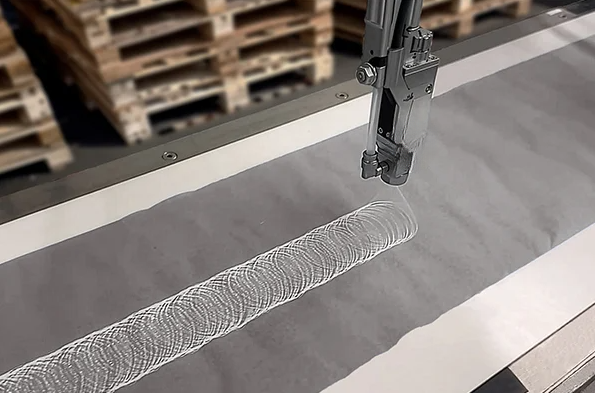
| Spiral spray | 1 500 – 6 000 | Hygiene, disposable products |
| Bead extrusion | 5 000 – 15 000 | Packaging, case sealing |
| Wheel / roller coating | 2 000 – 10 000 | Bookbinding, label stock |
| Edge banding gun | 8 000 – 25 000 | Furniture, panel processing |
| Fiberised spray | 500 – 3 000 | Mattress, automotive trim |
These ranges are guidelines. Always consult your equipment manufacturer’s technical data sheet for the exact viscosity window supported by your nozzle geometry, hose diameter, and pump capacity. For application-specific adhesive recommendations, Devote provides technical datasheets listing viscosity at multiple reference temperatures.
Factors That Influence Viscosity During Application
Temperature
Hot melt adhesive viscosity is highly temperature-dependent. A formulation rated at 5 000 mPa·s at 180 °C may register 10 000 mPa·s at 160 °C and only 2 500 mPa·s at 200 °C. This inverse relationship means that even a 10 °C drop in tank temperature — caused by a failing heater band or a long hose run — can push viscosity outside your equipment’s operating window. Best practice is to monitor tank temperature with a calibrated thermocouple and log it against production batch records.
Base Polymer Chemistry
The polymer base has the strongest influence on a formulation’s viscosity profile:
- EVA (ethylene-vinyl acetate): Typically 2 000–15 000 mPa·s. Versatile and widely used in packaging and bookbinding.
- Polyolefin (PO): Typically 3 000–12 000 mPa·s. Offers better thermal stability and lower density than EVA.
- Polyamide (PA): Typically 5 000–30 000 mPa·s. Higher viscosity but outstanding heat resistance for electronics and automotive.
- Polyester (PES): Typically 4 000–20 000 mPa·s. Excellent wash resistance for textile and footwear applications.
- SBC (styrenic block copolymer / PSA): Typically 500–5 000 mPa·s. Low viscosity, pressure-sensitive — ideal for hygiene and label stock.
Formulation Additives
Tackifying resins, waxes, and plasticisers are used to adjust viscosity within a polymer family. Higher wax content reduces viscosity and shortens open time; more resin increases tack and typically raises viscosity. Antioxidants and stabilisers do not significantly change viscosity but protect the formulation from thermal degradation during extended tank residence, which would otherwise cause viscosity to rise over time as the polymer crosslinks.
Matching Viscosity to Your Equipment: A Step-by-Step Process
- Check your equipment specifications. Locate the recommended viscosity range in your applicator’s manual or contact the OEM. Record the reference temperature at which the specification is given (most cite 180 °C, some use 160 °C).
- Identify your substrate requirements. Porous substrates (nonwovens, corrugated board) generally benefit from lower viscosity for penetration. Non-porous substrates (films, metals) may require higher viscosity to maintain bead shape and prevent runoff.
- Determine your line speed. High-speed lines (>200 m/min in hygiene, >40 cartons/min in packaging) often need lower viscosity to ensure adequate wetting within the open time window. Slower lines can accommodate higher viscosity grades.
- Review the adhesive technical data sheet. Confirm that the product’s viscosity at the reference temperature falls within your equipment’s range. Pay attention to the viscosity curve across the operating temperature range — a steep curve indicates the adhesive is highly sensitive to temperature fluctuations.
- Validate with a trial. Before committing to a production batch, run a small validation on your actual line. Measure adhesive consumption, bond quality (peel or shear test as appropriate), and any equipment issues (nozzle drip, stringing, pressure alarms).
According to data from the Adhesive and Sealant Council, approximately 60% of adhesive viscosity-related production problems could be avoided with a proper pre-production trial that verifies equipment compatibility under actual line conditions.
Common Viscosity Problems and How to Fix Them
Stringing and Cobwebbing
Long, thin adhesive strands between the nozzle and the substrate indicate that the adhesive’s melt strength is too high relative to its viscosity at the application temperature. Solutions include increasing the tank temperature by 5–10 °C, switching to a lower-viscosity grade, or adjusting nozzle-to-substrate distance.
Insufficient Wetting or Bond Failure
If the adhesive sits on the surface without penetrating, the viscosity may be too high for the substrate. Lower-viscosity grades, higher application temperatures, or longer open-time formulations are the standard corrections.
Charring and Viscosity Increase Over Time
When adhesive is held in the tank for extended periods (typically >72 hours at operating temperature), thermal oxidation can cause crosslinking, which raises viscosity and eventually produces charred particles. Using a formulation with adequate antioxidant content and practising regular tank purges — Devote recommends purging every 48–72 hours — prevents this degradation.
Devote’s Approach to Viscosity Consistency
As an ISO 9001 certified hot melt adhesive manufacturer based in Shenzhen, China, Devote maintains stringent viscosity control throughout production. Each batch undergoes Brookfield rotational viscometer testing at 180 °C (and additional reference temperatures on request), with acceptance criteria of ±8% of the target viscosity value — tighter than the ±10% industry norm. This consistency means that when you specify a Devote grade for your equipment, you can trust that every subsequent shipment will perform within the same viscosity window without recalibrating your application settings.
Devote produces EVA, PO, PA, PES, and PSA hot melt adhesives across a viscosity range spanning 500 to 30 000 mPa·s at 180 °C, supporting virtually all common application methods. Our technical team can also develop custom viscosity profiles for specialised equipment or substrate combinations.

Frequently Asked Questions
What is the standard reference temperature for hot melt adhesive viscosity?
The most common reference temperature is 180 °C, which aligns with standard Brookfield test methods and most equipment OEM specifications. Some European suppliers cite 160 °C. Always confirm the reference temperature before comparing viscosity values between different manufacturers.
Can I reduce viscosity by simply raising the tank temperature?
You can, within limits. Raising the temperature by 10 °C typically reduces viscosity by 25–40%, depending on the formulation. However, exceeding the adhesive’s recommended maximum operating temperature accelerates thermal degradation, changes open time, and may produce char. If you consistently need to run 15–20 °C above the grade’s nominal temperature to achieve the desired flow, you should switch to a lower-viscosity grade instead.
How often should I verify adhesive viscosity on the production line?
For critical applications (hygiene, medical, automotive filters), Devote recommends verifying viscosity at the start of each shift using a handheld melt viscometer or by checking the equipment’s pressure-flow baseline. For general packaging applications, weekly verification is typically sufficient. Any change exceeding ±10% from the established baseline warrants investigation before continuing production.
Get Expert Guidance on Viscosity Selection
Selecting the correct viscosity grade is not just about matching a number on a datasheet — it requires understanding your equipment’s hydraulic capabilities, your substrate’s surface energy, and your line’s speed and temperature profile. The technical team at Devote has helped hundreds of manufacturers across the filtration, hygiene, packaging, furniture, and automotive sectors optimise their hot melt adhesive viscosity selection. We offer free viscosity-matching consultations, trial samples, and on-site support for production line commissioning.
Contact Devote today to discuss your viscosity requirements and request product samples for your equipment validation.