Hot Melt Adhesive Application Equipment: Choosing Between Slot Die, Spiral and Bead Nozzles
Selecting the right hot melt adhesive application equipment is just as important as choosing the adhesive itself. The nozzle type, application method, and equipment settings directly determine bond quality, adhesive consumption, and line efficiency. Whether you are sealing cartons, laminating nonwovens, or assembling automotive filters, using the wrong application method can lead to stringing, inconsistent coverage, and costly rework.
This guide breaks down the three most common hot melt application methods — slot die coating, spiral spray, and bead application — and explains how to match each method to your production requirements and adhesive viscosity.
Why Hot Melt Adhesive Application Equipment Matters
Hot melt adhesives are thermoplastic materials that must be melted, precisely dosed, and applied at the correct temperature and pattern to achieve optimal performance. The application equipment controls four critical variables:
- Application temperature — typically 120–200 °C depending on adhesive chemistry
- Bead or coat weight — measured in g/m² or g/linear meter
- Pattern accuracy — the consistency of adhesive placement on the substrate
- Open time management — the window before the adhesive sets and loses tack
A mismatch between the adhesive viscosity and the nozzle design is one of the leading causes of poor bond strength, excessive adhesive use, and equipment fouling. Understanding the three main hot melt nozzle types will help you make the right investment.
Slot Die Coating: Precision Coverage for Wide Substrates
Slot die (also called slot nozzle or curtain coating) extrudes a continuous, uniform film of hot melt adhesive across a wide web — typically 50 mm to 1,500 mm in width. The adhesive flows through a precision-machined slot under pressure and lands on the substrate as a thin, controlled layer.
Best Applications
- Nonwoven lamination (hygiene products, medical drapes)
- Filter media bonding (pleated air and liquid filters)
- Textile and foam lamination
- Label and tape coating
Advantages
- Very uniform coat weight (±3–5% variation across width)
- Excellent for low-viscosity adhesives (500–5,000 mPa·s at application temperature)
- Minimal adhesive waste — no overspray or airborne particles
- Compatible with high-speed lines (up to 500 m/min in hygiene applications)
Limitations
- Requires consistent adhesive viscosity — viscosity fluctuations cause streaking
- Not suitable for intermittent or shaped patterns without servo-controlled shut-off
- Higher equipment cost compared to bead nozzles
Recommended adhesive viscosity: 500–8,000 mPa·s. Polyolefin (PO) and EVA grades with narrow viscosity windows perform best in slot die systems.
Spiral Spray: Flexible Coverage Without Full Contact
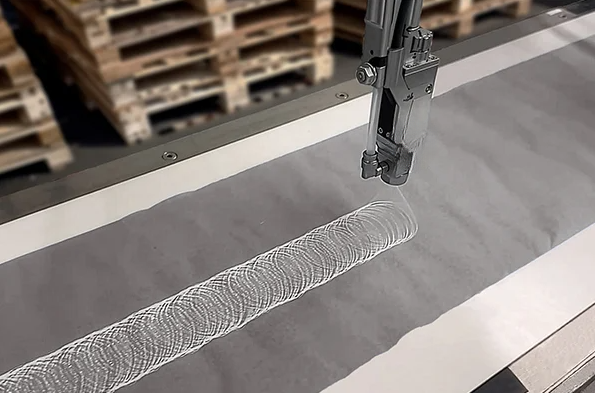
Spiral spray nozzles (also known as omega spray or swirl spray) use compressed air to atomize and rotate the adhesive bead into an open, overlapping spiral pattern. The adhesive is applied without direct contact with the substrate, making it ideal for delicate materials and situations where substrate surface contact must be minimized.
Best Applications
- Disposable hygiene product assembly (diaper elastic attachment, leg cuff bonding)
- Packaging flap sealing with irregular surfaces
- Bonding breathable or perforated materials where full-surface adhesion would block airflow
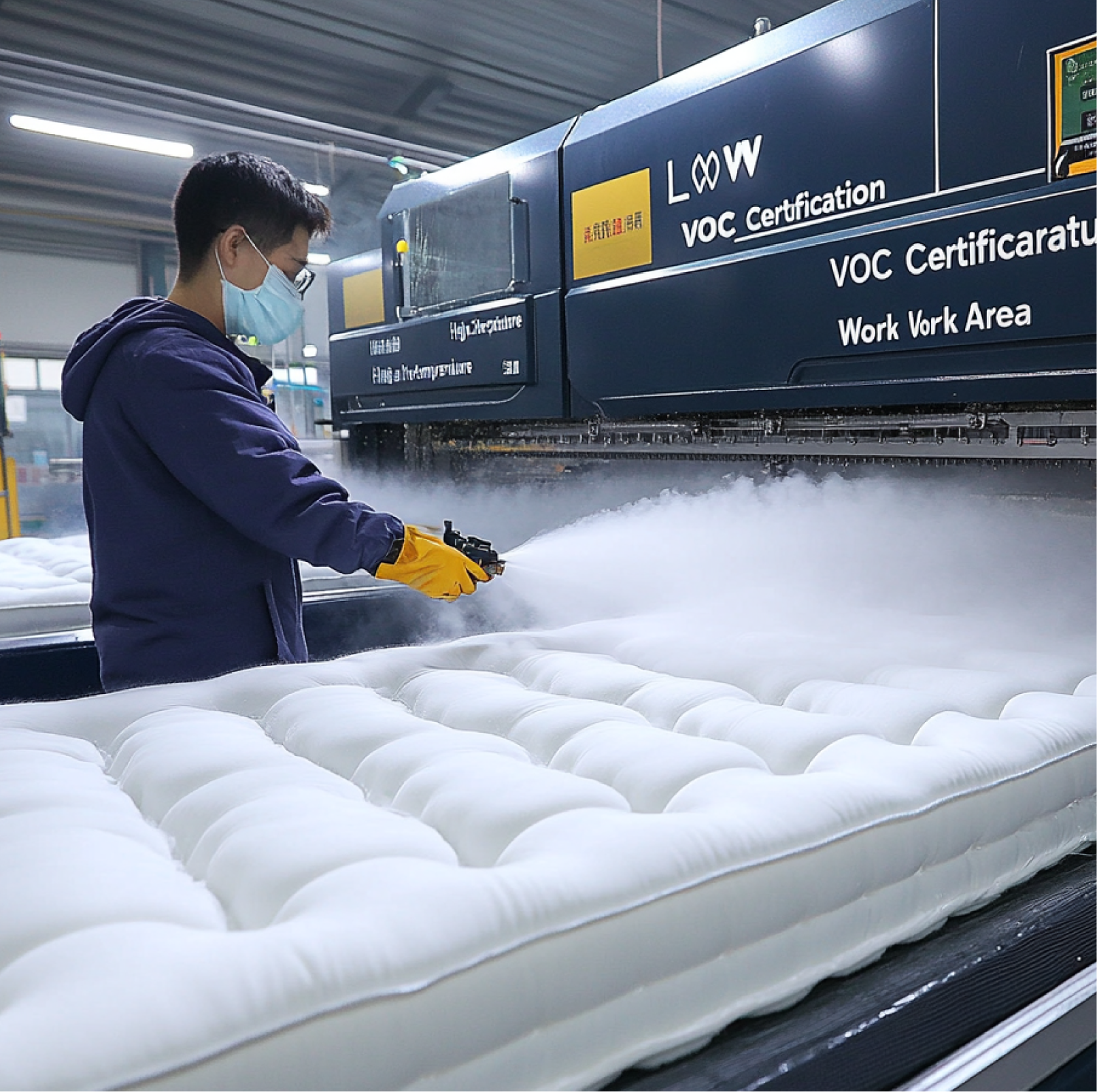
- Mattress and furniture assembly
Advantages
- Breathable bond — adhesive covers only 30–70% of surface area
- Excellent adhesion to elastic and stretch substrates
- Rapid pattern changeover by adjusting air pressure and nozzle distance
- Lower add-on weight achievable compared to slot die at equivalent bond strength
Limitations
- Overspray risk if air pressure or nozzle standoff distance is not precisely controlled
- Requires regular nozzle cleaning — adhesive char can clog air channels
- Not ideal for high-viscosity adhesives (> 15,000 mPa·s)
Recommended adhesive viscosity: 1,000–15,000 mPa·s. SBC (styrenic block copolymer) pressure-sensitive adhesives and low-viscosity EVA grades are commonly used with spiral spray systems.
Bead Application: Robust and Versatile for Structural Bonding
Bead application deposits a round or flat bead of hot melt adhesive using a single or multi-nozzle head. It is the most widely used method in industrial assembly, particularly where a precise line of adhesive must be placed along a seam, edge, or joint.
Best Applications
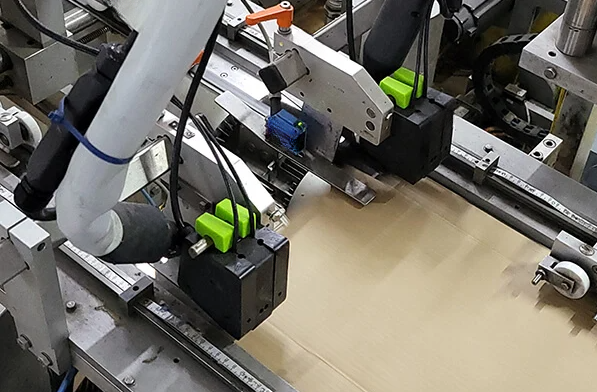
- Carton and case sealing in packaging lines
- Furniture edge banding (EVA and PO adhesives)
- Automotive filter endcap bonding and frame sealing
- Book binding and spine gluing
- Electronics potting and wire tacking
Advantages
- Simple, robust design with low maintenance requirements
- Handles a wide viscosity range — 1,000 to 50,000+ mPa·s
- Compatible with high-temperature adhesives (polyamide, PES) for demanding substrates
- Low initial equipment investment
- Intermittent or continuous application modes available
Limitations
- Not suitable for wide-area coverage without multiple nozzle heads
- Bead diameter consistency depends on pump pressure stability
- Stringing can occur if nozzle temperature is set too low or adhesive has poor cohesion
Recommended adhesive viscosity: 1,000–50,000 mPa·s. High-performance polyamide (PA) and PO adhesives with broad viscosity stability are well-suited for bead application in demanding thermal environments.
Equipment Selection Guide: Matching Method to Application
| Application Method | Best For | Viscosity Range (mPa·s) | Coat Weight Accuracy | Typical Industries |
|---|---|---|---|---|
| Slot Die | Wide web, full coverage | 500–8,000 | High (±3–5%) | Hygiene, Filtration, Textile |
| Spiral Spray | Breathable bonds, elastic substrates | 1,000–15,000 | Medium (±10–15%) | Hygiene, Packaging, Furniture |
| Bead Nozzle | Structural seams, edges, joints | 1,000–50,000+ | Medium-High (±5–8%) | Packaging, Automotive, Furniture, Electronics |
Viscosity and Temperature: The Critical Variables
Every hot melt adhesive has a viscosity curve — as temperature increases, viscosity drops. The application equipment must operate within the adhesive’s recommended temperature window to maintain the target viscosity for the chosen nozzle type.
For example, Devote’s PO-series adhesives typically reach 3,000–6,000 mPa·s at 160 °C — ideal for slot die systems. The same base polymer processed at 180 °C drops to 1,500–2,500 mPa·s, making it suitable for spiral spray. Exceeding the recommended temperature accelerates oxidative degradation, causing char buildup and nozzle fouling.
Key rule: always verify viscosity at application temperature before finalizing equipment selection. Request technical data sheets from your adhesive supplier with viscosity-temperature curves (mPa·s vs. °C).
Frequently Asked Questions
Q1: Can I use the same hot melt adhesive in both slot die and bead application systems?
In some cases, yes — if the adhesive’s viscosity at the intended temperature falls within both equipment ranges. However, the same adhesive grade may perform very differently across nozzle types. Slot die systems require tight viscosity consistency, while bead nozzles tolerate wider variation. Always test with the intended equipment and confirm coat weight accuracy before full-scale production.
Q2: What causes stringing in bead hot melt application, and how can it be fixed?
Stringing (also called cobwebbing or angel hair) typically occurs when the adhesive’s cohesive strength is too low at the application temperature, causing thin threads to form as the nozzle retracts. Solutions include: lowering the application temperature slightly to increase viscosity, selecting an adhesive with a higher molecular weight, improving nozzle shut-off speed, or reducing the nozzle-to-substrate distance. If stringing persists, the adhesive formulation may not be well-suited for your equipment configuration.
Q3: How often should hot melt application nozzles be cleaned or replaced?
Cleaning frequency depends on adhesive type, operating temperature, and production hours. As a general guideline: slot die nozzles should be inspected weekly and deep-cleaned monthly; spiral spray air channels should be cleaned every 2–4 weeks to prevent char blockages; bead nozzle tips should be checked daily for char buildup or tip wear. Using thermally stable, low-charring adhesives — such as Devote’s PO and PA series — significantly extends cleaning intervals and reduces downtime.
Choose the Right Equipment and the Right Adhesive Together
Hot melt application equipment and adhesive chemistry are inseparable. Optimizing one without considering the other leads to wasted material, poor bond quality, and excessive maintenance costs. Devote’s technical team in Shenzhen works with manufacturers across the filtration, hygiene, packaging, automotive, and furniture industries to match the right adhesive grade with the right application method for each production line.
Explore our full range of hot melt adhesive solutions on the Applications page, or contact our team for a free technical consultation. We supply EVA, PO, PA, PES, and PSA hot melt adhesives globally, with full technical support including viscosity-temperature data and application equipment compatibility guidance.
For further reference on industrial adhesive application standards, see the Pressure Sensitive Tape Council (PSTC) technical resources, which cover testing methods and application guidelines for adhesive systems.