Edge quality is where buyers judge panel furniture first. A white glue line between board and band. A corner that lifts weeks after delivery. Squeeze-out that shines after lacquer coating. Each of these traces back to one decision, the adhesive. Choosing a hot melt adhesive for edge banding furniture panels is a production decision, not just a purchasing line item. This guide covers the process, substrates and line speed. It compares EVA with PO. Then it shows how to fix the defects that cost you rework. Devote (Shenzhen Tongde New Material Co., Ltd.) has manufactured hot melt adhesives in Shenzhen for 17 years. Annual capacity is 10,000 tons.
Why Edge Banding Demands More From a Hot Melt Adhesive
Edge banding covers the raw core of MDF, chipboard and plywood panels. It seals moisture out, keeps formaldehyde emissions inside the board, and defines how the finished cabinet looks and feels. Compared with carton sealing, though, the bond faces a harder test.
- The joint is visible. Any thickness in the glue film shows up as a dark or glossy line after trimming and lacquering.
- The edge gets machined. Trimming, scraping and buffing units cut and heat the area where the adhesive sits, seconds after the bond forms.
- The speed is high. According to HOMAG’s published feed rates, entry-level edge banders run at 8-11 m/min. High-performance lines reach 15-40 m/min. Double-sided machines go up to about 50 m/min.
At those speeds the adhesive has a second or two to do its job. It must wet both substrates, build tack, and harden enough to survive trimming without squeezing out.
Inside the Edge Banding Process, and Where Failures Start
A throughfeed edge bander follows a simple logic. Granules melt in the glue pot. A metering roller lays a thin, even film of melt onto the panel edge or the band backing. Feed rollers carry the band in, pressure rollers press it home, and the trimming stations finish the joint.
Failures rarely come from bad adhesive alone. They come from a mismatch between the adhesive and the running conditions:
- Melt temperature drifting below spec, so viscosity climbs and wetting drops.
- Too much glue laid down, which squeezes out and reads as a thick line.
- Dust, oil or moisture on the edge, which blocks adhesion.
- Open time mismatched to line speed, so the band lands after the film has skinned over.
Every item on that list is fixable on the line. The rest of this guide therefore focuses on settings and defect diagnosis.
Substrate Types Shape the Adhesive Choice
Not all panels and bands behave the same under a hot melt film. MDF and chipboard are porous. They pull heat out of the melt while absorbing part of it, which usually helps mechanical keying. Melamine-faced panels are smooth and barely absorb anything, so wetting has to do more of the work. PVC and ABS bands are non-polar plastics. They need a formulation that wets them fast. They also need enough heat resistance to survive the friction heat of trimming. Wood veneer adds natural porosity and variable moisture content.
Two practical rules follow. Match the grade to your most difficult substrate, not your easiest one. And keep the edge surface clean, dry and at room temperature before it reaches the glue unit.
EVA or PO Hot Melt Adhesive for Edge Banding?
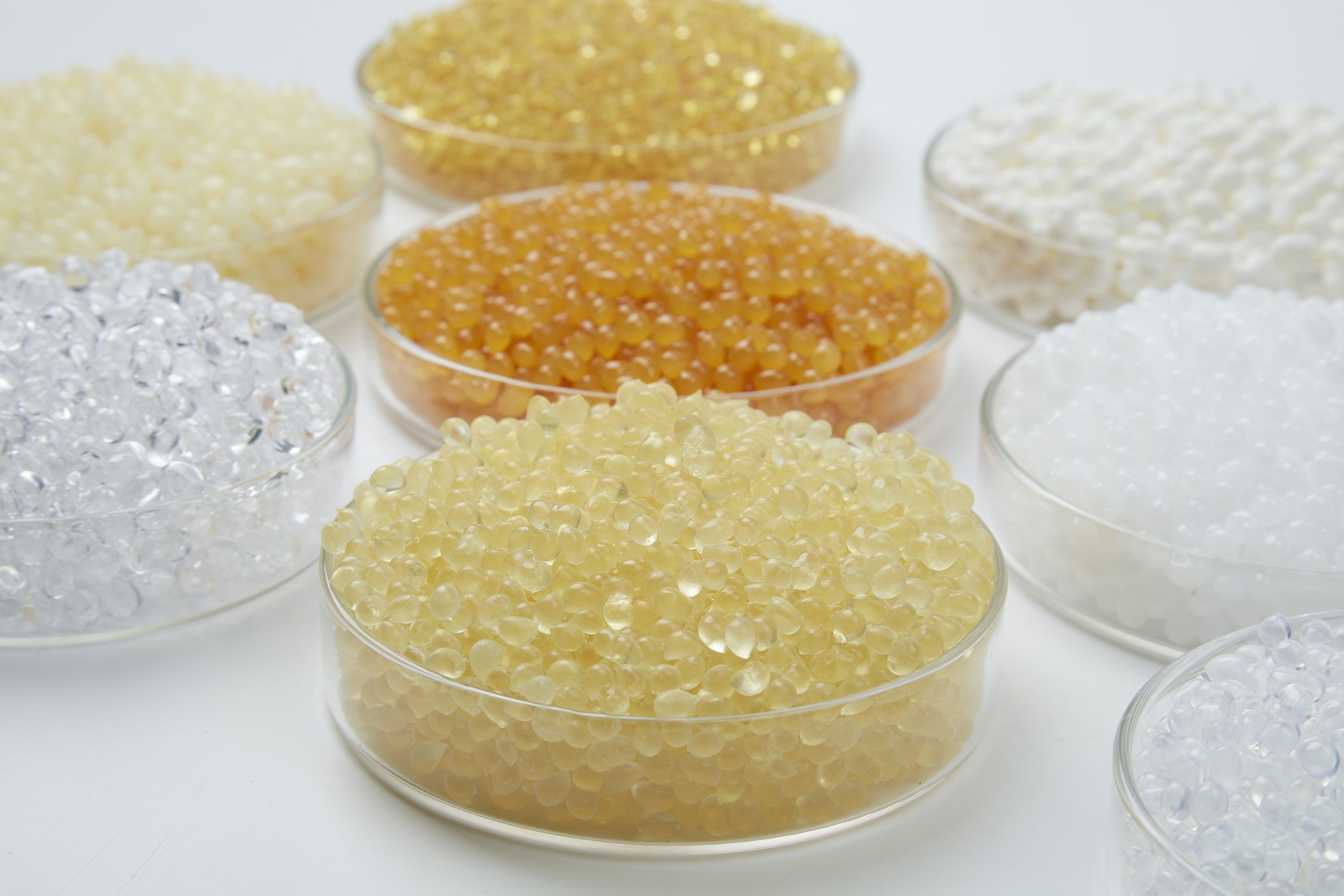
EVA-based adhesives are the industry default for edge banding. They wet a wide range of substrates and run at 150-180°C. Their cost profile suits most cabinetry and furniture work. Devote’s EVA grades for fast-curing assembly bonding are listed in the table below.
PO (polyolefin) adhesives cost more per kilogram but bring two advantages. They resist heat better, which matters near ovens, in hot climates or inside export containers. Their lower density also stretches each kilogram over more linear meters of edge. For a fuller comparison, see our EVA vs PO selection guide or browse the polyolefin hot melt adhesive range.
A reasonable starting point: standard furniture lines begin with EVA. Heat-exposed or high-humidity applications justify a PO trial.

Representative Devote EVA Grades and Specifications
The grades below come from Devote’s EVA range for fast-curing assembly bonding. Both suit edge banding on furniture lines. Both use raw materials compliant with GB 9685 (food contact materials and additives) and meet the RoHS 2.0 directive.
| Grade | 8082H | 8082W |
|---|---|---|
| Base | EVA | EVA |
| Color / shape | White granule | White granule |
| Softening point | 115±5°C (GB/T 15332) | 115±5°C (GB/T 15332) |
| Viscosity | 800±200 cps at 180°C (HG/T 3660) | 800±200 cps at 180°C (HG/T 3660) |
| Setting time | 1-3 s | 2-4 s |
| Operating temperature | 150-180°C | Tank 155-180°C, hose 150-170°C, gun 140-160°C |
| Packing | 25 kg bag | 25 kg bag |
Both grades store for 2 years below 40°C in a dry, cool place. The 1-3 second setting time of 8082H suits faster lines and the corner-lifting problem described below.
Production Line Tips for Clean Bonds
These settings separate a clean edge from a rework queue.
- Control each temperature zone separately. The glue tank, hose and gun run at different setpoints (see the 8082W column above). A gun set as hot as the tank chars adhesive at the nozzle.
- Match melt temperature to line speed. If you raise feed speed, raise temperature or move to a faster-setting grade. Cold melt at high speed is the classic cause of lifting.
- Meter the glue down. A thin, uniform film bonds better and stays invisible. Add application weight only when fiber tear or voids tell you it is needed.
- Keep panels at room temperature. Cold boards shorten open time and freeze the bond before the rollers finish their work.
- Never mix adhesive grades. Clean the pot completely at changeover. Mixed polymers can char and block filters.
- Rotate stock FIFO and avoid overnight heat soak. Most tank degradation comes from molten adhesive held too long, not from the granules themselves.
Qualifying a new grade? The EVA hot melt adhesive page lists the full range with technical data sheets.
Common Edge Banding Defects and How to Fix Them
- Visible or thick glue line: too much adhesive, or melt temperature too low. Reduce metering, then raise temperature toward the middle of the range.
- Corner lifting and edge lift-off: the set was too slow for your speed, or pressure was released early. A 1-3 s grade such as 8082H plus firm roller pressure usually ends it.
- Band falls off at trimming: substrate contamination, or temperature too low to wet PVC and ABS. Clean the feed path and raise the gun zone first.
- Stringing and smoke at the nozzle: overheating, or adhesive held molten too long. Check zone setpoints and tank change intervals.
- Wavy, streaky film: worn metering roller or viscosity drift. Verify viscosity at 180°C and inspect the roller surface.
Frequently Asked Questions
What temperature should EVA edge banding adhesive run at?
Most EVA grades run at 150-180°C. On a multi-zone machine, Devote recommends for 8082W a tank at 155-180°C, hose at 150-170°C and gun at 140-160°C. Start low, check the bond, then step up gradually.
Why does my edge banding glue line look thick and shiny?
Usually a combination of over-application and low melt temperature. Excess adhesive squeezes out and never levels. Cut the metering back, raise the temperature, and confirm roller pressure is even across the panel width.
EVA or PO hot melt for furniture edges: which should I choose?
Start with EVA for standard cabinetry. It is cost-effective and forgiving across substrates. Move to PO when edges face sustained heat or humidity. Think of kitchens near ovens, or export shipping through hot climates. Trial both with free samples before deciding.
Devote (Shenzhen Tongde New Material Co., Ltd.) manufactures EVA, PO, PA and PSA hot melt adhesives in Shenzhen. Quality systems are certified to ISO 9001 and IATF 16949, with REACH documentation available on request. Tell us your board type, edge material and line speed. Our engineers will recommend a grade and send free samples for a line trial. More on our factory and certifications is on the about page.