

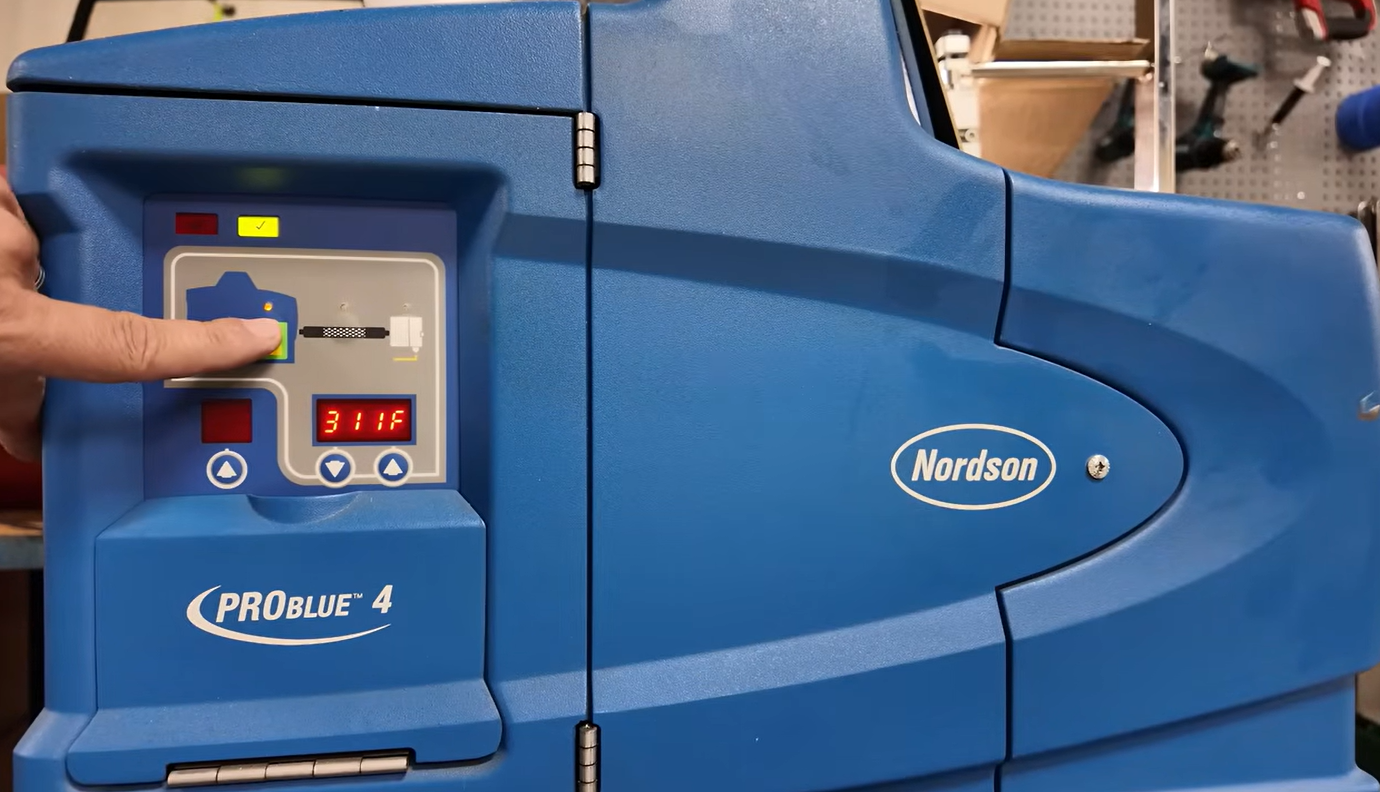
Getting the hot melt adhesive application temperature right is one of the most critical variables in any bonding operation. Set it too low and the adhesive will not wet the substrate properly. Set it too high and you risk charring, stringing, and accelerated equipment wear. For manufacturers running high-speed packaging, filtration, or automotive lines, even a 5 to 10 degree Celsius deviation can push peel strength below specification and trigger costly production rejects. In this guide, we break down exactly what application temperature means, how it varies by adhesive chemistry, and how to dial in the right settings on your production line.
What Is Hot Melt Adhesive Application Temperature?
Application temperature refers to the temperature at which the adhesive is dispensed from the nozzle or slot die onto the substrate. It is distinct from but closely related to the tank temperature, hose temperature, and nozzle temperature, all of which must be controlled individually in modern hot melt systems.
When a hot melt adhesive reaches its application temperature, it transitions from a solid to a flowable melt with a specific viscosity window. Within this window, the adhesive can wet the substrate, penetrate surface micro-pores, and form a strong mechanical bond upon cooling. Stray outside this window by even 10 to 15 degrees Celsius and bond strength can drop by 20 to 40 percent, depending on the chemistry. For critical applications such as high-temperature resistant adhesive bonding in HEPA filters, precise temperature control is non-negotiable.
Why Hot Melt Adhesive Application Temperature Affects Bond Performance
Temperature controls three interdependent process variables: melt viscosity, open time, and wetting ability. Understanding how these interact is the foundation of process optimization.
- Melt viscosity drops as temperature rises. Lower viscosity improves substrate penetration but makes bead control more difficult. Higher viscosity gives a cleaner bead profile but may prevent adequate wetting on porous substrates such as non-woven filter media.
- Open time increases with temperature. A higher dispensing temperature keeps the adhesive workable longer, which is critical for applications that involve substrate positioning or folding before compression. Most hot melt grades have a rated open time measured at a specific temperature. Deviating from this baseline changes the open time proportionally.
- Wetting ability depends on surface tension equilibrium between the adhesive melt and the substrate. At the correct temperature, the adhesive spreads evenly. Below that, it beads up on smooth surfaces. Above it, the adhesive may bleed through porous substrates.
According to industry data, improper melt temperature is responsible for approximately 38 percent of all adhesive-related production rejects in automotive filter assembly lines. This makes it the single largest quality variable under direct operator control.
Recommended Hot Melt Adhesive Application Temperature Ranges by Chemistry
Different polymer bases have distinctly different processing windows. The table below summarizes standard operating ranges used across Devote’s product lines:
| Adhesive Chemistry | Typical Application Temp (°C) | Max Safe Temp (°C) | Primary Applications |
|---|---|---|---|
| EVA (Ethylene-Vinyl Acetate) | 160 – 180 | 190 | Carton sealing, bookbinding, general packaging |
| PO (Polyolefin / APAO) | 150 – 175 | 185 | Filtration media, hygiene products, flexible packaging |
| PA (Polyamide) | 180 – 220 | 230 | Automotive filters, electronics, high-temperature assemblies |
| PES (Polyester) | 160 – 200 | 210 | Textile bonding, footwear, laminates |
| PSA (Pressure-Sensitive) | 130 – 160 | 170 | Labels, tape backings, medical devices |
These ranges represent the dispensing temperature at the nozzle. Tank and hose temperatures should be set 5 to 10 degrees Celsius lower to create a controlled thermal gradient and prevent overheating in the reservoir. For example, when running Devote’s 8088 PO series at 165 degrees Celsius nozzle temperature, the tank should be set to 155 degrees Celsius and the hose to 160 degrees Celsius.
How to Set and Control Application Temperature in Practice
Modern hot melt dispensing units feature separate temperature zones: tank, hose, and nozzle or manifold. Setting these zones correctly is as important as knowing the nominal application temperature.
Step 1: Start with the Adhesive Technical Data Sheet
Every reputable adhesive manufacturer provides a TDS with a recommended application temperature range. At Devote, all products ship with a TDS specifying tank temperature, hose temperature, and nozzle temperature, along with viscosity data at multiple test temperatures measured in mPa.s using a Brookfield viscometer at 160 degrees Celsius and 180 degrees Celsius.
Step 2: Calibrate Your Equipment Thermocouples
PID controllers on hot melt equipment can drift over time. A sensor that reads 170 degrees Celsius may actually be delivering 180 degrees Celsius at the nozzle tip. Use a calibrated contact thermometer or infrared pyrometer monthly to verify actual melt temperature against the displayed setpoint. In high-speed filtration and hygiene lines running at 200 plus meters per minute, even a 5 degree Celsius deviation can cause peel strength to fall below specification.
Step 3: Adjust for Substrate and Ambient Conditions
Cold substrates below 15 degrees Celsius act as heat sinks, rapidly chilling the adhesive melt upon contact and shortening effective open time. In cold-climate manufacturing facilities or cold-chain packaging operations, it is standard practice to increase nozzle temperature by 5 to 10 degrees Celsius above the nominal setting to compensate. Conversely, in tropical environments where substrate temperature may exceed 35 degrees Celsius, reducing the setpoint by 5 degrees Celsius can prevent bleed-through.
Step 4: Monitor Viscosity, Not Just Temperature
Because adhesive viscosity changes with both temperature and thermal degradation over time, high-output facilities benefit from inline viscosity monitoring. As adhesive ages in the tank, particularly EVA grades held at temperature for more than 4 to 6 hours, viscosity increases due to oxidation, requiring a higher temperature setpoint to maintain flow. Switching to Devote’s PO-based grades reduces this risk substantially. Polyolefin formulations are significantly more thermally stable and can remain at temperature for 8 to 12 hours without measurable viscosity drift.
Common Temperature-Related Problems and How to Fix Them
Temperature errors are behind the majority of hot melt application defects. Below are the five most common issues and their root causes:
| Problem | Likely Cause | Corrective Action |
|---|---|---|
| Stringing and cobwebbing | Temperature too high; low viscosity pulls threads | Reduce nozzle temp by 5-10°C; increase line speed or switch to higher-viscosity grade |
| Poor wetting and weak peel | Temperature too low; incomplete substrate wet-out | Increase nozzle temp by 5-10°C; check thermocouple calibration |
| Charring and brown discoloration | Temperature too high or extended idle time at temperature | Reduce tank temp; purge system with fresh adhesive; switch to PO grade for better thermal stability |
| Inconsistent bead width | Thermal gradient across nozzle; partial clogging | Clean nozzle; verify all heating zones are at setpoint; check hose insulation |
| Adhesive bleeding through substrate | Temperature too high or wrong viscosity for porous substrate | Reduce temperature and application weight; select a higher-viscosity or faster-setting grade |
Temperature Control in Filtration and Automotive Applications
In the filtration and automotive filter bonding segments, temperature control is especially critical because the bonded assembly must later survive the end-use thermal environment, not just the production line conditions. Cabin air filters, for example, are rated to withstand dashboard temperatures up to 80 degrees Celsius in summer. Engine oil filter end-caps must sustain continuous exposure above 130 degrees Celsius.
For these applications, Devote recommends PA-based hot melt adhesives applied at 190 to 220 degrees Celsius, with a tank setpoint 10 degrees Celsius below the nozzle setpoint to minimize thermal stress on the adhesive reservoir. The resulting bond retains full shear strength up to 150 degrees Celsius after cure, well above the ASHRAE and VDA 275 test thresholds for automotive interior air quality. Learn more about our high-temperature resistant adhesive solutions.
According to a 2024 benchmarking study by the Adhesive and Sealant Council, improper melt temperature is responsible for approximately 38 percent of all adhesive-related production rejects in automotive filter assembly lines. This makes temperature the single largest quality variable under direct operator control.

Frequently Asked Questions
What happens if hot melt adhesive is applied at too high a temperature?
Excessive temperature causes three problems. First, thermal degradation of the polymer chains increases adhesive viscosity over time and weakens bonds. Second, stringing and cobwebbing occur as the low-viscosity melt forms threads between the nozzle and substrate. Third, potential substrate damage arises, especially on heat-sensitive non-woven filter media or thin polyethylene films. Always observe the maximum safe temperature listed on the product TDS and never exceed it, even briefly.
How does hot melt adhesive application temperature affect open time?
Open time and application temperature are directly correlated. Higher temperature delays solidification by extending the time the adhesive remains above its crystallization point. For assembly operations that require positioning or folding before compression, such as multi-ply filter pleating, selecting a formulation with a longer rated open time and applying it at the upper end of the recommended range gives operators the most working window. For high-speed packaging lines where rapid set is a priority, the lower end of the range is preferred.
Can I use the same temperature setting for EVA and PO adhesives on the same equipment?
Not without adjustment. While EVA and APAO polyolefin adhesives overlap in their processing windows at roughly 160 to 180 degrees Celsius, the optimal setpoint differs. PO adhesives typically perform best 5 to 10 degrees Celsius below equivalent EVA grades because their lower application temperature is part of what reduces charring and extends pot life. When switching from EVA to PO on the same production line, always re-run adhesive qualification tests at the new temperature setpoints before committing to full production volume. Contact Devote’s technical team for a free application assessment.
Get Expert Temperature Guidance from Devote
At Devote, we manufacture industrial-grade hot melt adhesives including EVA, PO, PA, PES, and PSA grades for customers across more than 30 countries. Every product ships with a full Technical Data Sheet specifying optimal application temperature ranges, viscosity curves, and equipment recommendations. Our Shenzhen-based facility is ISO 9001 certified and produces over 10,000 metric tons annually.
Whether you are troubleshooting a stringing problem on your current line or evaluating a switch from EVA to polyolefin, our technical team is ready to assist. Learn more about Devote or contact us today to request samples, TDS documents, or a virtual application consultation. No minimum order is required for initial sample evaluation.

