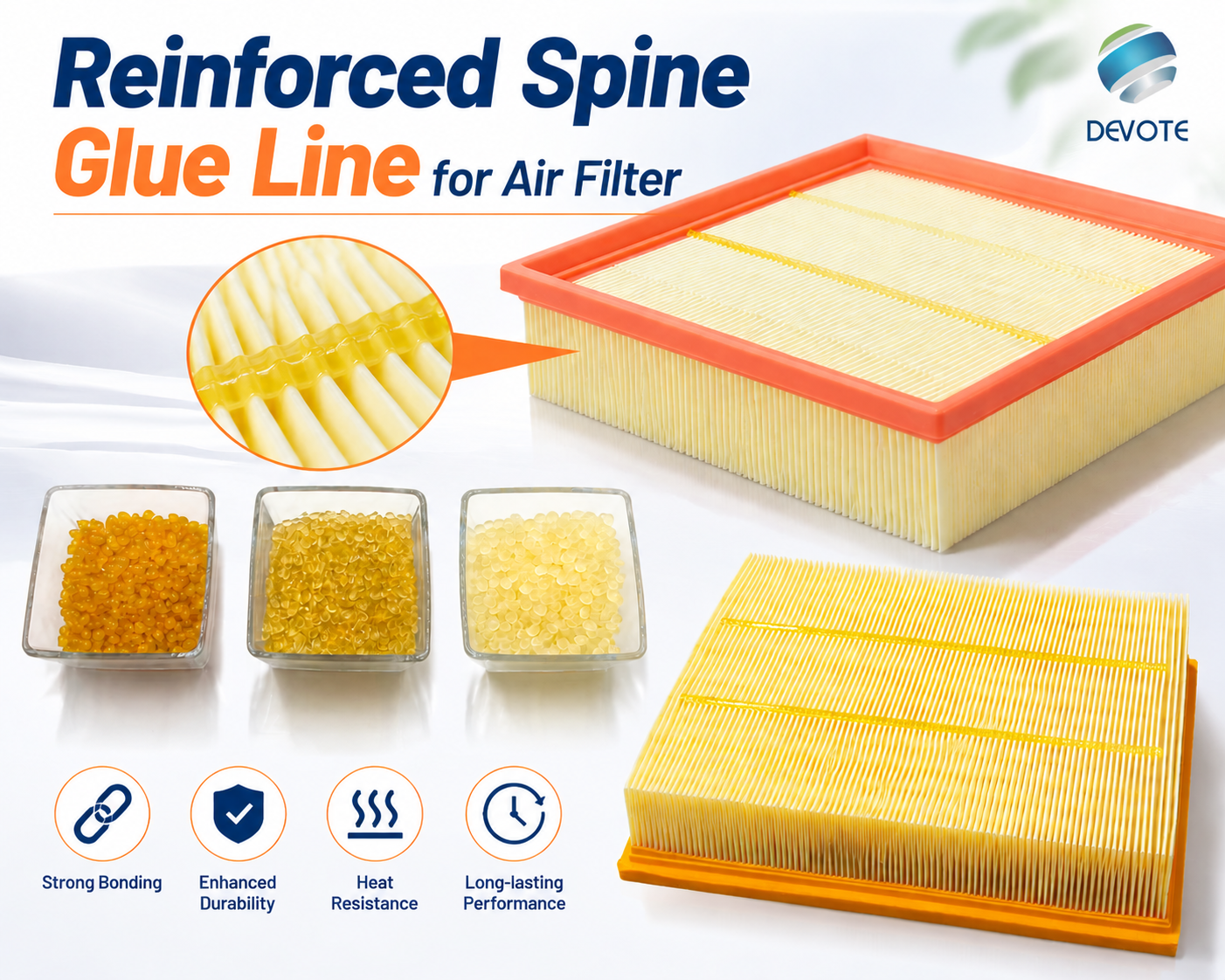
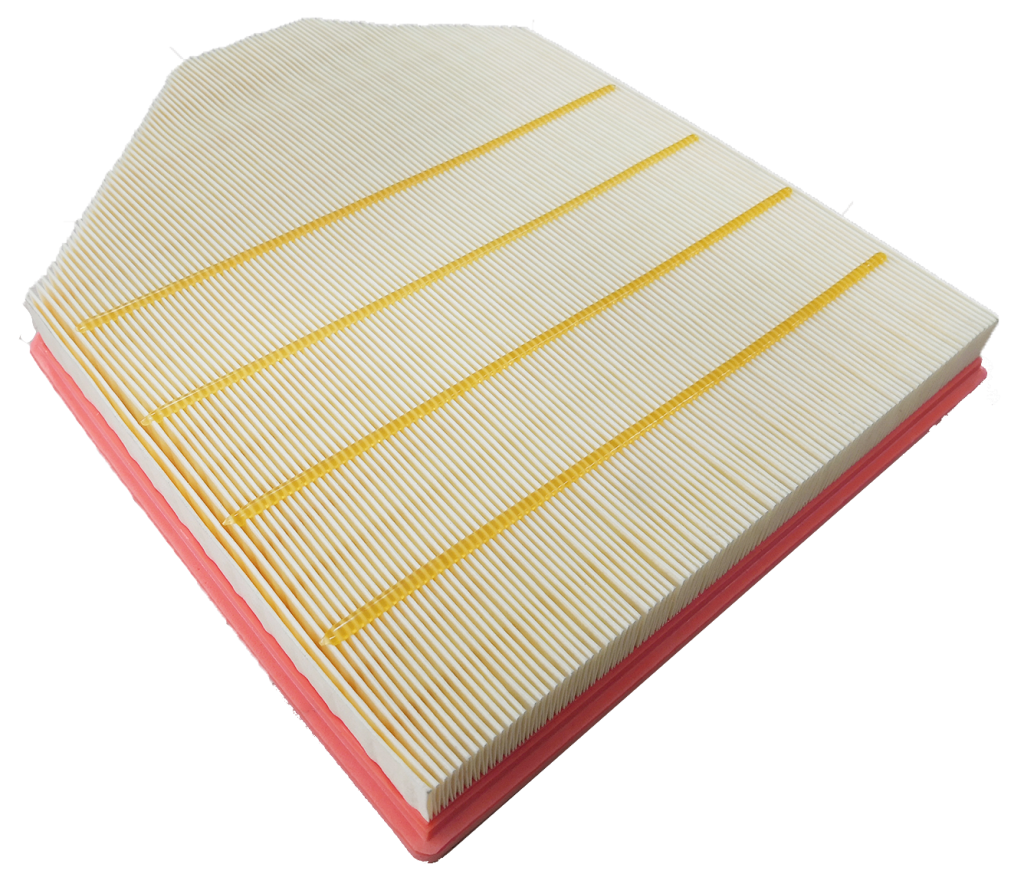
Polyolefin Hot Melt Adhesive for Reinforced Spine Line of Car Air Filter TONGDE 3081
Not every car operates under the same conditions. Turbocharged engines, hot climates, heavy-duty commercial vehicles, and performance-oriented driving all generate under-hood temperatures that can push well beyond the 80–90°C comfort zone of standard EVA adhesives. When intake air temperatures climb to 110–120°C, the reinforced spine line of the air filter needs an adhesive that will not soften, creep, or lose bond strength under sustained thermal load. TONGDE 3081 is a polyolefin (PO) hot melt adhesive for reinforced spine line of car air filter applications that demand elevated temperature resistance—delivering the thermal stability, adhesion performance, and production reliability that mid-range and high-performance filter manufacturing requires.
What Makes 3081 Different from EVA?
The fundamental difference between TONGDE 3081 and EVA-based alternatives like 3059A lies in the base polymer. While EVA (ethylene-vinyl acetate) provides excellent adhesion and cost-effectiveness at standard temperatures, its thermal ceiling is limited by the vinyl acetate copolymer structure, which begins to soften significantly above 90°C in service.
TONGDE 3081 uses a polyolefin (PO) base—a polymer family engineered for higher thermal performance. The PO structure provides a higher softening point (150±5°C, compared to 110±5°C for EVA-based 3059A), which translates directly to a higher service temperature rating of 110–120°C. This means the reinforced spine line bonded with 3081 maintains its structural integrity and pleat-spacing function even when the filter element operates in the elevated temperature environments common to:
- Turbocharged and supercharged engines — where compressed intake air generates higher temperatures
- Hot climate markets — Middle East, South Asia, desert regions of the Americas
- Heavy-duty and commercial vehicles — sustained high-load operation generating more under-hood heat
- Performance and sports vehicles — aggressive driving with high RPM operation
The Reinforced Spine Line Under Thermal Stress
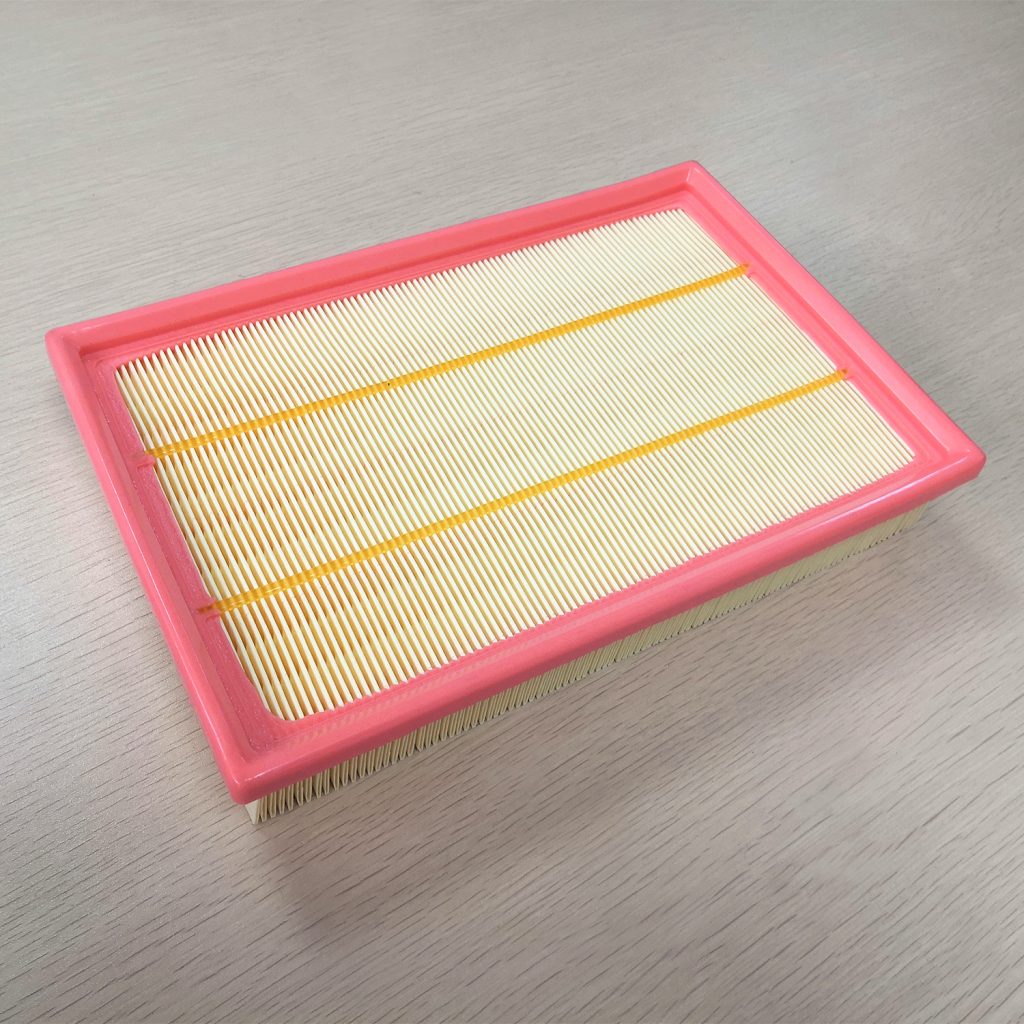
Understanding why temperature resistance matters for the spine line requires considering what happens when the adhesive softens under heat. The reinforced spine line is a structural element—it carries mechanical load. When the adhesive in the spine line softens, several failure modes become possible:
Pleat Collapse: As the adhesive bead loses rigidity, the pleats it holds in position begin to shift closer together under airflow pressure. This reduces the effective filter media area and increases pressure drop, degrading filter performance and potentially triggering a “check engine” or “replace filter” warning.
Spine Line Displacement: A softened adhesive bead can deform under vibration and airflow pulsation, shifting from its designed position along the pleat depth. This changes the pleat spacing pattern and may create areas where pleats are too close together (reducing airflow) or too far apart (reducing filtration efficiency).
Bond Failure at Substrate Interface: At elevated temperatures, the adhesive’s adhesion to the filter paper substrate can weaken, leading to partial or complete delamination of the spine line from the paper surface—rendering the structural reinforcement function entirely ineffective.
TONGDE 3081’s PO-based formulation addresses all three failure modes by maintaining cohesive strength and substrate adhesion at temperatures where EVA-based adhesives begin to lose performance.
Viscosity and Application
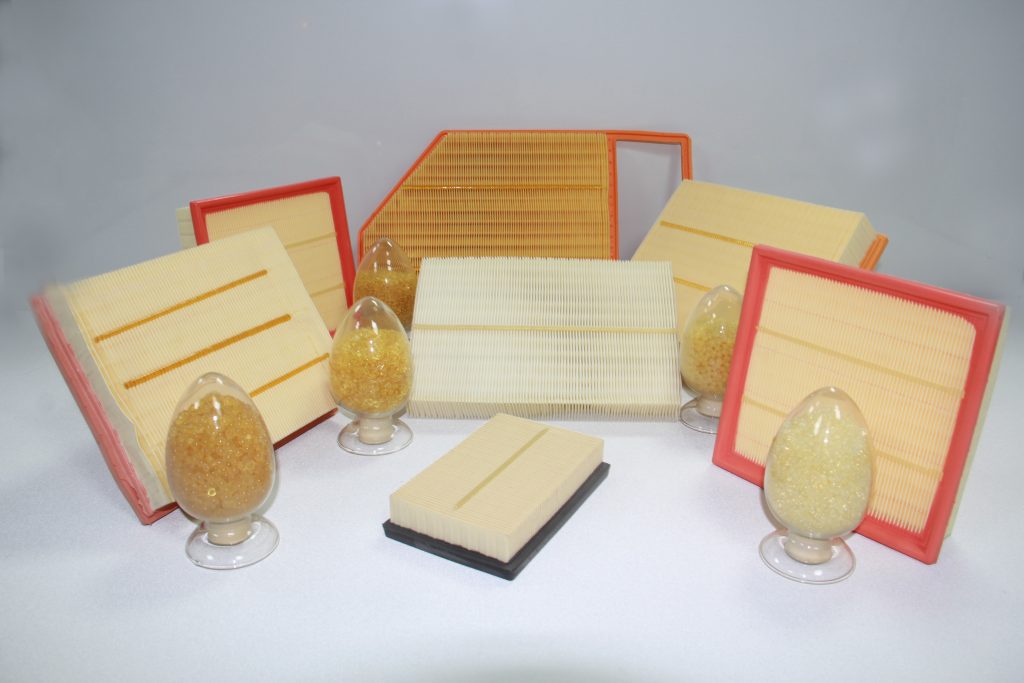
With a viscosity of 10,000±2,000 cps at 180°C, TONGDE 3081 has a higher melt viscosity than EVA-based alternatives. This is a deliberate design choice: the higher viscosity provides greater bead body and shape retention on the filter paper after application, ensuring the spine line maintains a consistent cross-sectional profile even on vertical or angled application surfaces. The viscous bead resists sagging and running before it sets—critical for maintaining a uniform spine line geometry across the full width of the filter element.
TONGDE 3081 is applied at 180–200°C (melter), with hose and gun temperatures at 160–180°C. The higher application temperature compared to EVA grades reflects the PO polymer’s higher melting point and ensures optimal flow and wetting on the filter paper substrate. The adhesive is compatible with all conventional application methods: spraying, rolling, coating, and scraping.
Adhesion to Filter Paper
Despite the higher viscosity and application temperature, 3081 delivers excellent adhesion to the filter paper substrates used in automotive air filter manufacturing. The PO formulation is engineered to wet and penetrate the cellulose and synthetic fiber networks in automotive filter media, creating a strong mechanical interlock that resists peel and shear forces throughout the filter’s service life.
Technical Parameters
| Parameter | Value | Test Method |
|---|---|---|
| Base | PO (Polyolefin) | — |
| Color | Yellow | Visual |
| Shape | Granular | Visual |
| Softening Point | 150±5°C | GB/T-15332 |
| Viscosity | 10,000±2,000 cps / 180°C | HG/T-3660 |
| Setting Time | 2–5 s | — |
| Operating Temperature | 180–200°C (melter) | — |
| Compliance | REACH, RoHS 2.0 | — |
| Packaging | 25 kg/bag | — |
| Shelf Life | 2 years (<40°C dry) | — |
When to Choose 3081 Over 3059A
| Selection Factor | Choose 3059A (EVA) | Choose 3081 (PO) |
|---|---|---|
| Service Temperature | ≤80°C | 80–120°C |
| Engine Type | Naturally aspirated | Turbocharged / performance |
| Climate | Temperate | Hot / arid |
| Vehicle Type | Standard passenger car | SUV / commercial / heavy-duty |
| Cost Priority | Maximum economy | Performance-critical |
Compliance
TONGDE 3081 meets both EU REACH and RoHS 2.0 requirements.
Packaging & Storage
25 kg bags, 2-year shelf life below 40°C in dry storage. For samples, technical data, and bulk pricing, contact the sales team.